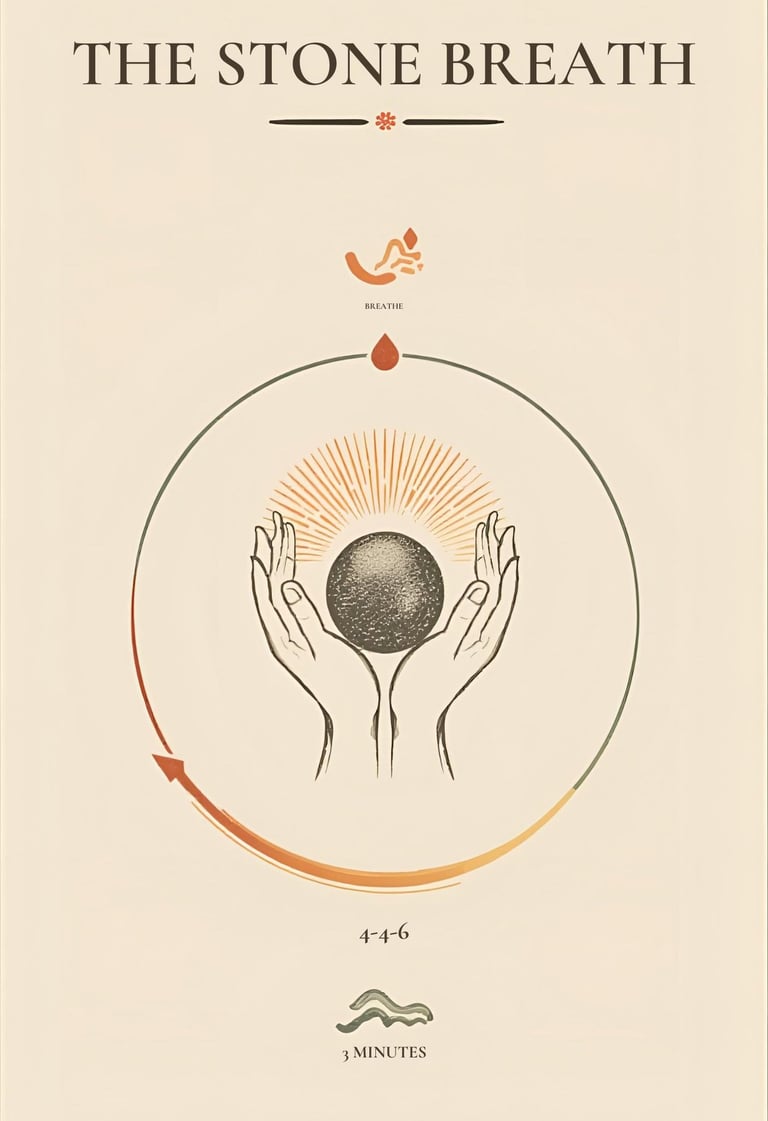
THE STONE BREATH
Navajo • 3 to 5 minutes • Centering
WHAT IT DOES FOR YOU
Calms your nervous system in under 3 minutes
Lowers heart rate and reduces cortisol
Interrupts anxious loops before they spiral
Gives you a physical anchor to focus on the texture of the pebble/stone
Portable, private, professional — use it anywhere, no one needs to know
WHEN TO USE IT
First thing in the morning, before you touch your phone
Before any difficult conversation you've been dreading
Walking into a boardroom where you need to be centered
After receiving difficult news that wants to throw you off
During a work break when stress peaks
At night when your mind won't stop spinning
Any time you need to remember that you can carry what you're carrying
THE STORY BEHIND IT
Over a hundred years ago, a young man ran on the high desert of Big Mountain. He ran against runners from other tribes — the pueblos, the Plains nations, even the coast. He won. Not because he was faster. Because he had a secret.
He ran with a small stone in his mouth.
It forced him to breathe through his nose. It kept him calm when his lungs burned. It taught him to carry weight without panic. The stone didn't make him faster. It made him steadier.
They called him Sorefoot. Not as an insult — as a testament. The soreness meant he had pushed to the edge of his capacity, then pushed further. The name Keediniih still runs through many offspring on the Navajo Nation today.
Sorefoot had a daughter. He taught her the stone, the run, the discipline. She grew up watching him race, learning from him, carrying his teaching in her bones.
Her name was Masan.
Masan carried the stone through her life — through the sheep camps, through raising her own children, through the relocation when the government took Big Mountain, through everything. She held four hundred sheep and four hundred souls together with hands that never stopped moving.
And when her great-grandson Tonas came to her at five years old, fresh from a fractured home, Masan placed a stone in his palm at dawn and said:
"The gods are walking. Don't let them find you asleep."
Tonas carried that stone through the red dust of Big Mountain. Through the fluorescent halls of Fort Lewis, where he forgot everything. Through the dark years when the stone sat in a drawer, buried under caffeine pills and highlighters, gathering dust.
When he finally remembered it, everything began to heal.
That stone is still in his pocket. And now, you can carry one too.
HOW IT WORKS — THE SCIENCE
Nasal breathing: Forces air through the nose, releasing nitric oxide. Increases oxygen absorption and activates the parasympathetic nervous system.
4-4-6 pattern: Inhale for 4 counts, hold for 4, exhale for 6. The longer exhale signals safety to the brainstem.
Physical anchor: The stone gives your mind something to focus on. This interrupts rumination loops and prevents spiraling.
Repetition: Five rounds in a row builds a neural pathway — stone + breath = calm.
Daily practice: Repeated over time conditions your nervous system. The response becomes automatic.
The vagus nerve runs from your brainstem to your abdomen. Slow breathing, especially longer exhales, stimulates it. This activates the parasympathetic nervous system — the "rest and digest" mode — and deactivates the sympathetic "fight or flight" response.
In plain language: Your body gets the signal that you are safe. You can think clearly again.
WHY 3 MINUTES IS ENOUGH
0-60 seconds: Heart rate begins to drop
60-90 seconds: Vagus nerve activates parasympathetic response
90-120 seconds: Cortisol production decreases
120-180 seconds: Rumination loops interrupt, mental clarity returns
The 4-4-6 pattern is clinically proven to shift your nervous system faster than any other duration. You don't need an hour. You need a signal. Three minutes is that signal.
GLOBAL PARALLELS
Navajo: Stone in mouth while running — Breathe through the burn; carry weight without panic
Lithuanian: First water drawn at dawn — The first resource of the day must be intentional
Japanese: Misogi purification at dawn — Cleanse the spirit before battle; begin with clarity
Different mountains. Same sunrise. Same stone. Same breath.
THE TEACHING
The stone doesn't remove the weight. It just reminds you that you can breathe while carrying it.
Sorefoot knew this. Masan knew this. Now you know it too.
Sorefoot figured it out a hundred years ago. Modern science has spent millions confirming he was right. The stone is still cheaper.
You are not alone. You never were.
The stone is not just a rock. It's a portal. Through it, you can visit anyone who came before.
THE INVITATION
Find a stone today. Not tomorrow. Today.
It doesn't have to be perfect. It doesn't have to come from a sacred river. It just has to fit in your pocket and feel right in your hand.
Put it in your pocket. When the world gets loud, feel it. Breathe.
That's the whole practice. The rest will come.
EXECUTIVE KEY TAKEAWAYS
Stone: Find one today. Keep it with you.
Practice: 5 breaths, 4-4-6 pattern, 3 minutes
When: Morning, before stress, after stress, anytime
Why: You can carry anything if you remember to breathe
Science: 4-4-6 activates vagus nerve; 3 minutes is clinically proven
Layers: 3 min daily / 8 min deep / 20 min ceremonial / 15 min ancestral
Integration: Use it all day — touch stone, one breath, reset
The Practice: 4 Layers
LAYER 1: STANDARD PRACTICE (3 mins)
This is your daily anchor. Use it every morning, and anytime the world gets loud.
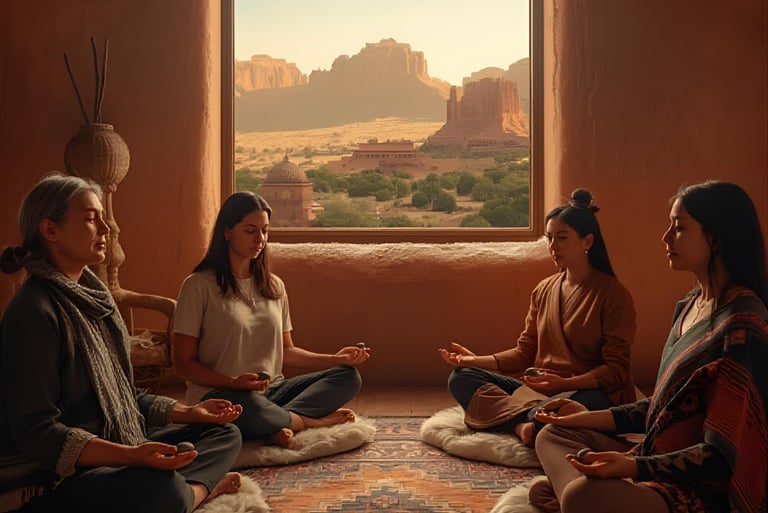
Step 1: Find a small, smooth stone. Keep it in your pocket, your desk, your nightstand.
Step 2: When the world gets loud, take the stone in your hand.
Step 3: Close your eyes. Bring the stone to your lips. You don't need to put it in your mouth. Just the touch reminds your body.
Step 4: Breathe in through your nose for a count of 4. Feel the air. Feel the stone.
Step 5: Hold for a count of 4.
Step 6: Breathe out through your nose for a count of 6.
Step 7: Repeat five times. That's about 90 seconds. Do five rounds.
Step 8: Open your eyes. Return the stone to your pocket. You are ready.
LAYER 2: EXTENDED PRACTICE (8-10 mins)
Use this before sleep, after intense stress, or as a deeper daily anchor.
Arrival (1 min): Hold the stone. Eyes closed. Just notice. Don't change anything.
Breathing (5 min): 20 rounds of 4-4-6. Count each round. If your mind wanders, return to the stone.
Body scan (2 min): With the stone in your hand, scan from head to toe. Where is tension? Breathe into it. Exhale, release.
Integration (2 min): Ask silently: "What am I carrying that isn't mine?" Let the stone hold it. Don't fix. Just notice.
LAYER 3: CEREMONIAL PRACTICE (20+ mins)
Use for retreats, deep personal work, or when you need a profound reset.
Space: Create a small altar — stone, candle, meaningful object.
Sound: Open with a bowl, drum, or silence.
Intention: State aloud what you're releasing or inviting.
Breath: 20-30 minutes of 4-4-6 with periods of silence between rounds.
Journal: Write what arose — insights, feelings, questions.
Closing: Thank the stone. Return it to your pocket
LAYER 4: THE ANCESTRAL LAYER — VISITING YOUR ELDER (15-20 minutes)
This is not something you do every time. But when you need depth — when you need to remember that you are not alone — this layer is waiting for you.
Step 1: Settle. Complete the Standard Practice first. Let the stone ground you. Let the breath settle your nervous system. You are now ready to travel.
Step 2: Invite. With the stone in your hand, close your eyes. Call to mind an ancestor, an elder, a wisdom keeper — someone whose presence you long for. It could be a grandparent you actually knew, an ancestor you never met but feel in your blood, a teacher who shaped you, a figure from history or tradition who represents wisdom to you. Masan. Ada. Dineh. Alfonsas. They are here. Say their name silently. Three times. Let the name settle in your chest.
Step 3: Visit. Imagine yourself in their presence. Where are you? In a hogan at dawn? In a Lithuanian forest? At a kitchen table? By a fire? See them. Notice their hands, their eyes, the way they hold themselves. Approach them. Sit with them. You don't need to speak yet. Just be in their presence.
Step 4: Greet. When you're ready, greet them. In whatever way feels right: "Grandmother, I'm here." "Masan, it's me." "I've come to sit with you." Or just silence — they already know.
Step 5: See Through Their Eyes. Now gently shift. Imagine looking out through their eyes. See the world as they saw it. What did they value? What did they carry? What broke their heart? What gave them hope? What would they say about what you're carrying right now? Don't force answers. Just let impressions arise. The stone in your hand is the same stone they might have held. You are connected through it.
Step 6: Receive. Ask them one question. Silently. Simply: "What do you want me to know?" "How do I carry this?" "What matters most right now?" Then wait. Don't manufacture an answer. Just wait. Sometimes the answer comes as a word, an image, a feeling in the body, a sudden knowing. Sometimes it comes days later. The waiting itself is the practice.
Step 7: Thank. When you feel complete, thank them. In whatever way feels right: "Thank you, Grandmother." "Ahéhee', Masan." "Ačiū." A simple nod. A hand on your heart.
Step 8: Return. Take three stone breaths. Feel the stone in your hand. Feel your body in the room. Open your eyes. You are back. But you are not alone.
Why This Works:
Invitation: You're not demanding — you're opening a door.
Specificity: Naming them makes them present.
Silence: You're not filling the space with your own noise.
Receiving: You're open, not grasping.
Gratitude: Completes the circuit.
You are not talking to a hallucination. You are activating the part of yourself that carries them. They live in you. This practice just lets you feel it.
THE STONE ITSELF
Finding it: Let the stone find you. Walk a riverbank, a beach, a path. The right stone will feel right in your hand.
Cleansing: Hold under running water. Leave in moonlight. Pass through sage smoke. Set intention.
Naming: Some people name theirs. "This is my Sorefoot stone." "This is my Masan."
Passing: Eventually, you may pass it to someone who needs it. The circle continues.
BREATH VARIATIONS
Calming (standard): 4-4-6 — Daily practice, stress, anxiety
Energizing: 4-4-4 — Morning, before alertness needed
Deep reset: 4-7-8 — Sleep, deep anxiety, after trauma
Box breathing: 4-4-4-4 — High-stakes moments, SEALs use this
WHAT TO FOCUS ON DURING PRACTICE
Sensory: Texture, temperature, weight of the stone
Breath: Count, sensation of air moving through nostrils
Body: Where is tension? Breathe into it.
Emotion: What am I feeling? Let it be there. Don't fix it.
Thought: Watch thoughts like clouds. Return to stone.
Ancestral: Imagine Sorefoot running with this same stone. Masan holding it at dawn. You are not alone.
INTEGRATION THROUGHOUT YOUR DAY
Morning: Full 3-minute practice before phone
Pre-meeting: Touch stone in pocket, one conscious breath
Post-stress: 30-second reset — stone + one 4-4-6 round
Evening: Extended practice or journal with stone nearby
Night: Stone under pillow — touch if you wake anxious
JOURNAL PROMPTS
After any practice, ask yourself:
What was I carrying that I didn't know I was carrying?
What felt lighter after breathing?
Where in my body was the tension?
What wants my attention tomorrow?
What would Sorefoot say about how I'm carrying this?
What would Masan tell me right now?
Connect
Reach out for questions or book pre orders
Wisdom@ancestralwatch.com
© 2026. All rights reserved.