
The author
Tony Skrelūnas
“I teach the far messenger principles — and I write the stories that carry them.”
Keh Yazh → Masan → Ada → Tony → You
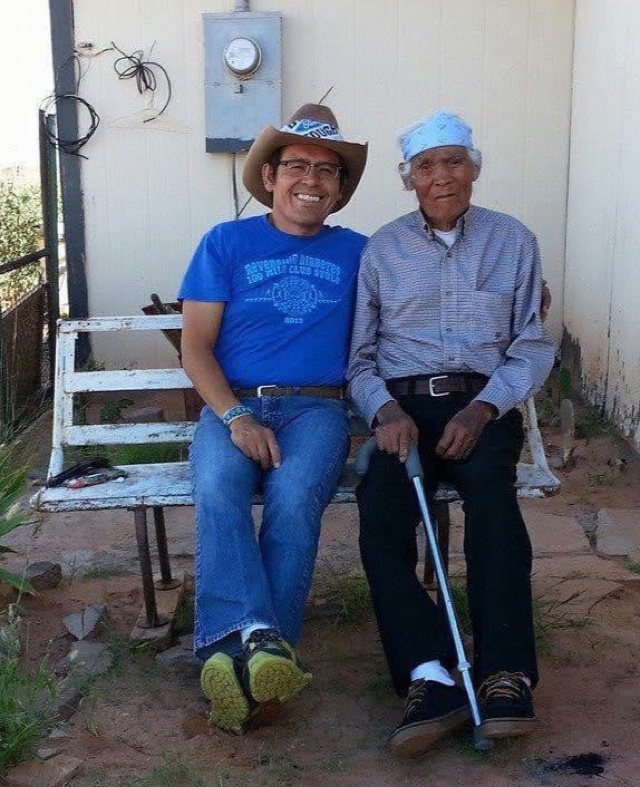
Above: with my grandfather, who lived to 103.
The raising
A hogan on Big Mountain, and a kerosene lamp.
No electricity. Four hundred sheep. A ceremony every dawn, before the day was allowed to ask anything of him.
He was raised by his great-grandmother. The day started outside, facing east, with corn pollen and a song — the oldest continuous performance-management system on the continent, and nobody in that camp would have called it that.
He learned to read by kerosene lamp. And by that same lamp he read the philosophy of Japan, and has studied that tradition ever since and drawn on its disciplines — studied, not inherited. Three inheritances, then: two that came down the line and one he walked toward.
What the camp taught was not romance. It was method. How to spend nothing you don’t have to. How to hold a state when the weather turns. How to count wealth in four accounts instead of one — people, land, knowledge, and only then money.
Everything in these books came out of that camp first, was tested in a working life second, and is now the subject of doctoral research third. Lived, proven, studied.
The return
He remembered who he was — and his power came back.
College handed him an identity crisis and an inferiority crisis at once — a world that quietly required him to be someone generic, and made him feel smaller for not being it. For a while he tried to be it. He drifted from the teachings he was raised on.
What turned it was a single realisation: he could be who he was. Not a version of himself sanded down to fit the room. He walked back in, and finished at the top of his class.
That is the whole argument of this work. The tools were never lost. They were only set down.
The record
He carries the credentials the way the old carriers carried rank.
Produced when the room needs them. Never worn.
- PhD candidate in Sustainable Development Education, Prescott College
- Dissertation on human and organizational performance through three lenses — Diné, Lithuanian, Japanese
- Faculty at 1440 Multiversity
- First person of Lithuanian and Diné descent inducted into the W. A. Franke College of Business Hall of Fame, Northern Arizona University
- Decades as an executive and systems architect, leading institutional change at scale — including the restructuring of a still-deeply-cultural nation’s government to return real governance, and real ownership, to its local communities
- A runner, and an aspiring silversmith
The books
The Ancestral Watch series — Stone Breath and The Council Fire out now, two more coming.
The research
Doctoral research on how human high performance is built through ancestral tools — Baltic, Diné, and Japanese.
The gatherings
Retreats and councils, including The Canyon Within at 1440 Multiversity.
The coaching
For leaders, athletes, teams and communities carrying more than they were built to carry alone.
Twelve years · the high desert
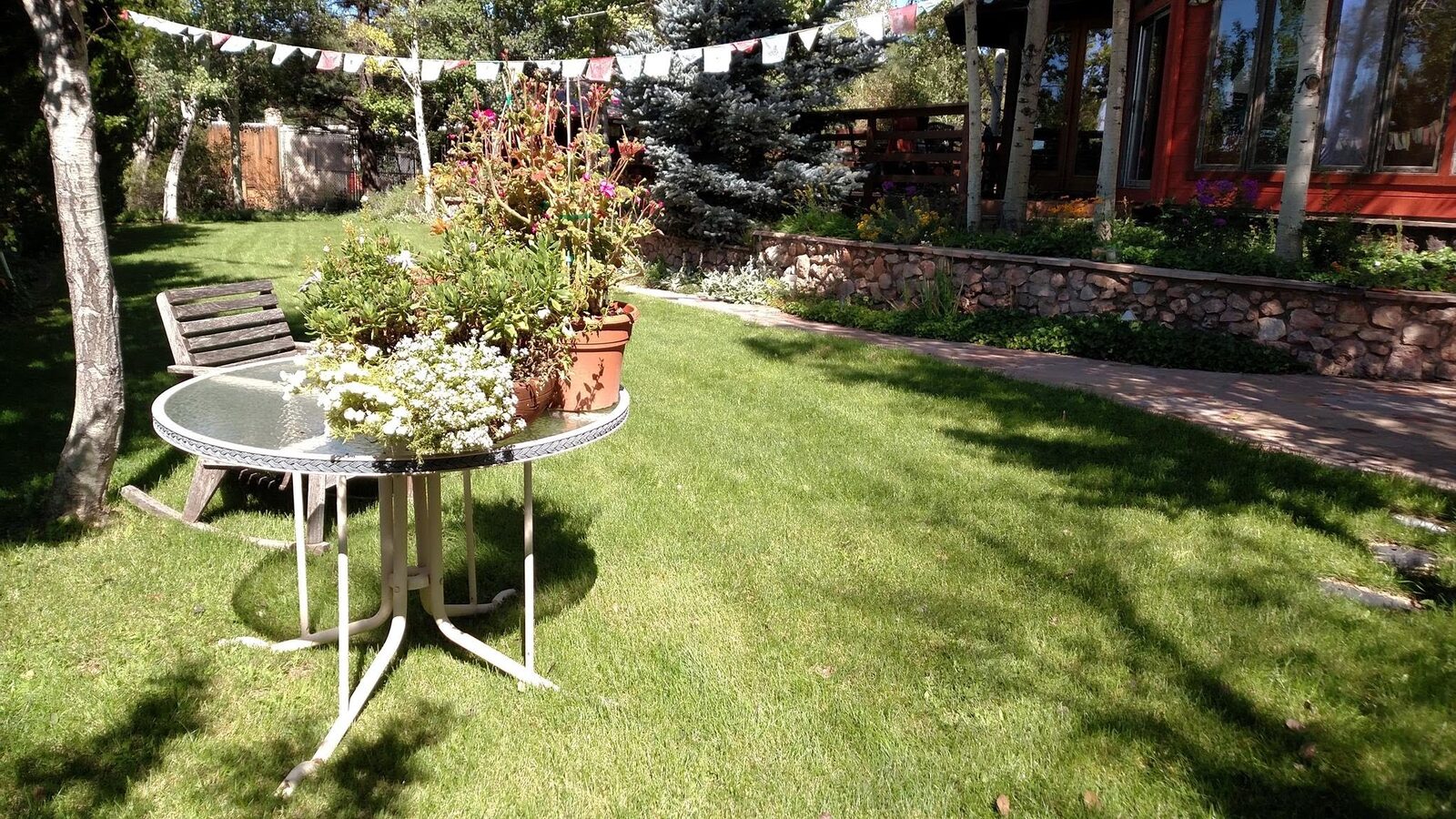
He built a Japanese garden where nothing should grow.
A koi pond. A waterfall. A torii with a Buddha beneath it. An arched stone bridge. A meditation room framing a sacred mountain. Then he sold the house, and let it go.
It took twelve years, and it was never a project. It was the Japanese discipline made physical — restraint, repair, and the discipline of doing one thing completely before starting the next. He hauled the stone. He set the bridge. He learned what a waterfall needs at seven thousand feet.
People asked whether it hurt to leave it. It did. It was also the point. A garden in the high desert is a lesson in impermanence you build with your own hands and then hand back — which is the same lesson the camp taught, in another language, on the other side of the world.
You build the thing completely. Then you hand it back.
On letting the garden go
The method
A metamodernist, and deliberately a hopeful one.
Refusing both the modern claim that the old knowledge was superstition, and the postmodern claim that no knowledge is truer than another.
The ancestral practices were tested — ten thousand years of field trials with survival as the endpoint. The laboratory findings are real. Neither has to defeat the other. Fiction can carry working instruction. A ceremony can be described by its effect without disclosing its content. A practice can be honoured and examined at once.
That is not a hedge. It is the only position from which this work can honestly be done.
And the through-line of everything he makes is that the tools were never lost — only set down — and that a person, a family, a whole people can pick them back up.
The inheritance is still there. Most of us are richer than we were ever told.
Go deeper than a book
Coaching, retreats, and the keynote.
One-to-one work for leaders carrying weight; immersive gatherings that bring the practices off the page and into the body; and stages and boardrooms that need ancient operating systems for continuity. All of it lives at the sister site.
Stay in touch
Write to me.
Readers, booksellers, translators, students, and anyone who wants to pick the tools back up.
wisdom@ancestralwatch.comI read everything. I answer what I can.