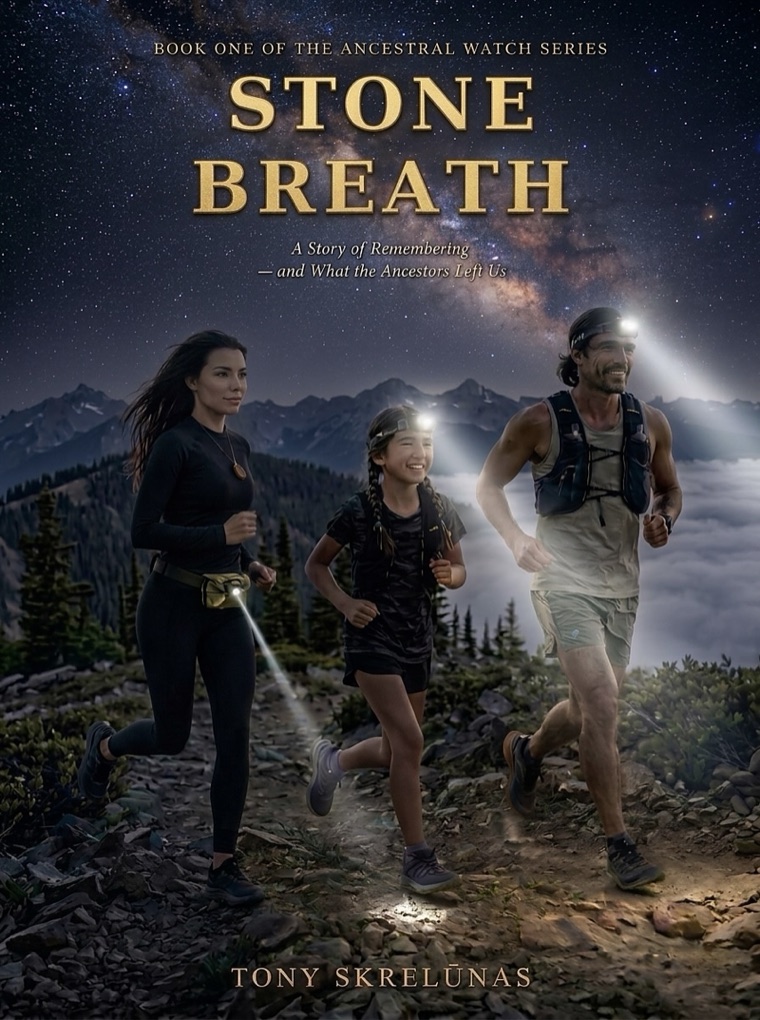
Book One · Stone Breath
Read Chapter Two free.
Listen · 22 min
22:27
Stone Breath
Chapter TwoThe Box He Carried
“Kas išeina, tas niekada neišeina iki galo.” — One who leaves never fully leaves. Lithuanian proverb
“She saw him before he saw her. Which was good, because if he’d seen her first, he probably would have gotten back on the bus.” — Tonas Yazzie
“Even the longest journey begins with a single step.” — Japanese proverb
She saw him before he saw her.
The bus from Vilnius pulled up to a dusty village shelter, and a man stepped off holding a cardboard box wrapped in a woven blanket. He stood there for a moment, looking around like he was waiting for the ground to tell him where to go.
Austėja watched from the heritage center window. She’d seen a lot of visitors over the years. This one was different. Tired, she thought. Not in the body. In the soul.
She was thirty years old and had spent all of them in this village except four. The man standing on the square was thirty-two and had spent his everywhere there was to spend them, and she could see from the window, before he had said a word to her, that it had not worked.
She went out anyway. She had not planned to. She was halfway across the square before she had decided anything.
“You are Tonas.”
“I am.”
“You look like your grandfather.”
“You have never met my grandfather.”
“I have seen a photograph.” She picked up one of his bags without being offered it. “It was a small photograph. I stand by it.”
He stood there holding the bundle with both arms, like a man handing over something at a border.
“You can put that down,” she said.
“I’d rather not.”
She looked at it, then at him, and something in her face moved and then decided against it. “All right,” she said. “Then carry it. It is four hundred meters. You will survive.”
The bundle was lighter than it should have been.
Tonas held it on his lap as the bus rattled east from Vilnius, past Soviet-era apartment blocks giving way to pine forest, then birch, then more pine. The bundle held his grandfather’s most treasured possession—a small, worn book of Lithuanian dainos, wrapped in a wool blanket Ada had woven years ago. Storm pattern. Black and white and gray.
He had built a life that looked successful from the outside. Master’s degree from Hitotsubashi. A global consultancy with clients on four continents. Keynotes in Geneva and Tokyo. Rowing at dawn on the Tama River when the shell ran true and the mind went quiet. He had earned the awards, the respect, the money.
But somewhere along the way, the dawn run had become a workout. The stone breath had become a technique. He knew the tools the way you know the words of a song you no longer feel. There was a small block—nothing dramatic, nothing visible—but he felt it. A quiet drift. A sense that he was going through motions he had once loved.
That was why he was on this bus. Not to prove anything. To remember. To see if the old code still lived in him, waiting to be unlocked.
He touched the stone in his pocket. Warm. Always warm.
He thought of his Lithuanian grandfather, Vytautas. The garage in Oregon. The smell of grease and gasoline. The sound of a welder’s torch. Every year, Vytautas flew to Arizona and drove the miles to Big Mountain to visit Tonas. He always had a picture of new motorcycle —something he’d built himself, something nobody had ever seen. He raced those bikes up hills that would break a normal man’s neck. Into his seventies. Didn’t stop. Didn’t slow down. He sold his custom motorcycles to people all over the world. And when he wasn’t building or racing, he played golf. Avid. Relentless. The same focus he brought to everything.
“The rake, the trail, the swingarm pivot,” he’d say, measuring a frame with a carpenter’s square. “Every angle matters. A few millimeters changes everything. Same as your running form. Same as building a hogan. Same as anything worth doing.”
He visited every year until Tonas was in his early twenties. Then he couldn’t travel anymore. But he never stopped calling. Never stopped asking about the land, the sheep, the stone.
He was late. The bus had been delayed. He didn’t apologize. “Navajo time,” he said to the driver, who didn’t understand. The driver stared. Tonas shrugged. He was used to people not getting it.
The bus smelled of diesel and wet wool. He closed his eyes and let the memory come: the smell of juniper smoke from Masan’s fire, the feel of wool between his fingers as he carded, the sound of her voice before dawn—not singing, just humming, the way she always hummed when the day was new. The mesa. The red cliffs. The sheep moving like clouds across the canyon floor. He opened his eyes. The bus was still rattling. The pines were still blurring past. He touched the stone in his pocket. Warm.
An old woman across the aisle clutched a sack of potatoes. A young man in a tracksuit stared at his phone. No one looked at the American with the wrapped bundle, which was fine. Tonas didn’t feel like explaining.
He’d told Ada he was going. She’d nodded, said nothing for a long time, then: “Your grandfather waited his whole life to go home. You’re doing the right thing.”
“What if there’s nothing left? The village—it’s small. They might not even remember the name.”
Ada had looked at him with that expression she had—the one that said you’re young and you don’t understand time yet. “Forests remember,” she said. “Even when people forget.”
Tonas stared out the window. The pines blurred past. He thought of the first time he’d left the reservation—not for school, but for a trip north. Uncle Kee Bahé had loaded him and six cousins into a truck and driven to Yellowstone. Tonas had read about geysers in a book by kerosene light, sitting on the floor of the hogan while Masan hummed and the sheep settled outside. When he finally stood at the rim and saw steam rising from the earth, he didn’t say anything. Neither did Uncle Kee. That was the thing about Uncle Kee: he didn’t narrate. He just brought you to the edge of the world and let you look.
That evening, at the KOA campground, they ate in the little restaurant. Tonas ordered a hamburger, french fries, and a root beer—his first time ordering from a menu. The root beer came in a cold glass, dark and fizzing, and he drank it slowly because he wanted it to last. Uncle Kee watched him with that quiet pride he never put into words.
The world in the books was real. That was what Yellowstone taught him. Lithuania was real too. He just had to get there.
It was not only Lithuania he reached for by that lamp. It was Japan.
He had sent away for the books with money saved from herding, and when they reached the trading post he carried them home like something alive. The Book of Five Rings, by a swordsman named Miyamoto Musashi, who had won sixty duels and then gone into a cave to write down what he knew. And Bushidō: The Soul of Japan, which promised to explain a code older than the country he lived in. He read them the way he read everything in those years — all at once, then again slower. Earth, Water, Fire, Wind, Void. Honor. Discipline. The idea that a warrior’s truest strength was not in the arm but in the mind. A still mind. A mind like water, that took the shape of whatever held it and was not troubled.
Alone in the hogan, or out where the only witness was the sheep, he tried to become it. He moved through the stances the pages described, slow and serious, a boy on a mesa imagining himself a swordsman an ocean and four hundred years away. He tried to think the way he imagined they thought. Calm before the strike. Empty of fear. Present.
And in one of those books he found the breathing. Not from the chest, it said. From the center — low in the belly, below the navel. Breathe from there, and the panic has nowhere to sit. Breathe from there, and you reach mushin — no-mind — the still place a warrior must find before he can move without hesitation. He tried it that night by the lamp. In, slow, down to the center. Out, slower. The noise in his head dropped a notch. His shoulders came down. It was the first breathing practice he ever learned on purpose — and he did not know yet that Masan had been teaching him the same thing at dawn, in a different language, with a stone instead of a sword.
Years later, when the counselors expected him to stay close for school and he chose Tokyo instead, he could not fully explain it to them. But he could hear his grandfather. Hastiin had been moved off Big Mountain — relocated, the government called it, as if a word could make it gentle — and yet Hastiin had stayed whole. So had Ada. They did not sit in grief. They picked up their stones and they walked and they built again. The Diné had always been a moving people, his grandfather told him: following the sheep with the seasons, traveling for marriage, for trade, for the pursuit of what a life required. To move was not exile. To move was to live. The danger is getting comfortable. A person who gets comfortable stops growing. That is true of the seasons. It is true of your whole life.
So before he left, Tonas did what the old people taught when you leave sacred ground. He went up to the mesa one last time — not to hike it, to say goodbye to it. He found a small stone that had already come loose on its own, already waiting, and he put it in his pocket. I carry you with me, he told the land. Not as weight. As witness. Then he got on the plane. He was not leaving his people behind. He was doing the most Diné thing he knew how to do — refusing to get comfortable, carrying the mountain inside him, moving toward what he needed to learn.
And it was not only books that crossed the water to him. He had written a letter once — a boy’s dare to himself, an address off the back of a magazine, a village under the Swiss Alps. A boy his own age wrote back. His name was Urs. They were both mountain boys, it turned out. Both ran. Both knew what it was to live where the weather had a temper and the nearest town was a long way down. The letters were slow — weeks each way — but they kept coming, year after year, two boys flinging a line across the whole curve of the earth. Tonas did not know yet, kneeling by the lamp with a thin envelope from Switzerland in his hands, that Urs would walk beside him the whole length of his life.
The bus stopped in Zarasai. Tonas got out, stretched his legs, waited for the connection to Antalieptė. A woman at the ticket counter looked at his destination, then at him. “You’re going to Antalieptė? There’s nothing there.”
“I know.” She shrugged. “Bus leaves at four. Wait over there.”
He waited. The bundle sat beside him on the bench.
The connecting bus was smaller, older, driven by a man who looked like he’d been driving it since the Soviets left. Tonas was the only passenger. They rattled through more forest, past farms with wooden barns and metal roofs, past lakes that caught the low autumn light.
The driver caught his eye in the rearview mirror. “American?”
“Yes.”
“Visiting family?”
“Bringing something home for my grandfather. A book his father carried across a border a hundred years ago.” The driver nodded. “My grandmother is buried in the forest near here. No marker. Just trees. She knows where she is.”
Tonas looked out the window. The pines blurred past. He thought of his mother, who had moved back from the city to have him, then returned to work, leaving him with Masan before he could walk. He never felt abandoned. He felt placed. Masan raised him from the time he was one. She was his mother in every way that counted. He thought of his father, dead when Tonas was four. A photograph on Ada’s dresser. A handful of stories. He had never visited the grave. Ada offered once. He said no. He wasn’t ready. He looked at the trees. Maybe now he was.
He wore a simple linen shirt, earth-toned, and dark pants. Around his wrist, a cord with turquoise—the stone Masan had given him. His hair was pulled back in a bun. Silver earrings caught the light. He wore it the way the ancestors wore their regalia: not for show, but for honoring them.
The driver asked where he was going. Tonas started to answer and pointed—a small motion with his lips. That was the Navajo way. You didn’t point at a person or a sacred thing with your finger. The driver stared at him. Right. Not here. Tonas pointed with his finger. The driver nodded.
Sheeps, he thought. The word for the plural. Over a thousand sheeps. He almost smiled. He was very far from home.
He had a master’s degree from Hitotsubashi in Tokyo. He had rowed there—not because he loved it at first, but because someone had challenged him. “You’re from the desert. You’ve never seen this much water in your life.” He had looked at the river, then at the oar. “Give me an oar.” He had figured it out. By the end of the season, he was in the bow seat.
His father had been Lithuanian. More the shape of someone who should have been there than a memory. Vytautas had told him once: your father said this land looked like the mesa in certain lights. Red rock instead of amber. But the same quality of morning.
Antalieptė materialized out of the forest. A church spire first, white against the gray sky. Then wooden houses with carved trim, their windows glowing amber. A river—the Šventoji—curved around the town.
The bus stopped at a small shelter near a stone mill. The driver pointed. “Heritage center is that way.”
Tonas stepped off. The air was cold and clean, full of pine and damp earth and something else. Something he recognized but couldn’t name.
He stood for a moment before moving. Not performing—reading. Masan had taught him this without calling it a lesson. You read a place before you read its people. The land tells you what you need to know first. This land said: old, patient, full of things not said aloud. He recognized the quality immediately. The mesa said the same thing in a different language.
He walked toward the mill. Old, built of field stones and red bricks, with a water wheel that no longer turned. A sign on the door said Antalieptės Krašto Paveldas. He opened the door.
The woman behind the desk looked up. Dark hair pulled back. A face that didn’t smile automatically. She was on the phone, speaking rapid Lithuanian, and held up a finger.
He waited.
She stood with the stillness of someone who ran forest trails before dawn. Her hands were strong—chef’s hands, gardener’s hands, athlete’s hands. She wore all black. The amber at her throat caught the lamplight. She moved like she owned the room. Which she did.
When she finally set down the phone and looked at him, her gaze was not hostile, not welcoming—just assessing.
“Can I help you?”
“I’m looking for information about my family. They lived here, I think. A long time ago.”
“What name?”
“Vytautas. He left in 1944.”
Something flickered in her eyes. “There’s no one here by that name now.”
“I know. He—“ Tonas hesitated, then held up the bundle. “He asked me to bring this back. A book his father smuggled. I think it belongs here.”
She looked at the bundle. At the blanket wrapped around it. At his face.
“You’re his grandson.” It wasn’t a question.
“Yes.”
She studied him for a long moment. Then: “My grandmother has letters. Letters from America. She’s been keeping them for fifty years.”
Tonas felt something loosen in his chest. “She’s alive?”
“Alive and stubborn and seventy-four years old. She’ll want to meet you.”
She stood and came around the desk. She was taller than he’d thought.
“I’m Austėja,” she said. “Welcome to Antalieptė.”
She didn’t smile, but something in her eyes softened. Just slightly.
He’d booked a small bed-and-breakfast outside town. The confirmation was in his email, the address saved on his phone. But Austėja shook her head before he could mention it.
“You’re not staying there,” she said. “The village has a sodyba — a guest farmstead. I keep the keys.”
“I don’t want to impose.”
“You’re not imposing. It’s separate from the main house. Ona would never forgive me if I let you sleep in a stranger’s bed.”
She led him to a small building behind the mill. It was simple — a single room with a wood stove, a narrow bed, and a window facing the river. The sheets smelled of lavender. A few old books sat on a shelf. This was where the village put up visiting researchers, traveling craftsmen, anyone who needed a clean place to sleep and didn’t ask for much.
“It’s not much,” she said.
“It’s perfect.”
He set down his bag. The stone was warm in his pocket. He lay awake for awhile, listening to the water, wondering if he’d made a mistake coming here. But the stone stayed warm. And in the dark, he almost smiled.
MASAN Put the phone down.
I mean it. Whatever you were just reading, whatever you were just carrying — it will still be there in sixty seconds. Right now, I need you to breathe.
My father ran with a stone in his hand, imagining it on his tongue. Not a big one. Small. Smooth. The kind the river leaves on its banks for free. He ran twenty-mile races with it. Won some of them. Against men who had been training longer, running farther, sleeping better. You know what they didn’t have? The stone. The breath. The discipline to stay calm when the lungs are burning and every instinct says gasp.
He gave it to me. I give it to you. That is how this works.
Find a stone. Any stone. River stone if you can — smooth, small enough to sit in your palm. If you don’t have one, use your thumb. We will get you a real stone later. For now, thumb is fine. I am not precious about this.
Hold the stone in your palm. Feel its weight — small, smooth, cool. Notice how just holding it lightly softens your jaw. Your cheeks let go. Your face relaxes. That is already the first breath.
Now: breathe in, light and easy — through your mouth and nose together. Four counts. Hold — four. Breathe out, slow — six. Hold — four. That is one. Do five. I will wait.
[ Do it now. This paragraph is not going anywhere. ] There. Your shoulders dropped, didn’t they. Your jaw unclenched. Your mind got quieter than it has been all morning. That is not a trick. That is your parasympathetic nervous system doing exactly what it was built to do. Your body already knew this. It was just waiting for you to remember.
The ancestors walk at dawn. Do not let them find you holding your breath. Do this every morning. At the door. Before anything else. The full practice — with every variation your life might need — is in the back of this book. But you already have everything you need. You have the stone. You have the breath. You have sixty seconds.
Use them. T he ones who taught him Through this story you will hear from the people who raised him. Some are gone. Some are still alive and would be annoyed to be described this way. They arrive at the end of chapters, when they have something to say, and they say it to you directly rather than to him.
There is no fixed set of them and no order. That is not how it works. You call whoever you need, and the one who answers is usually not the one you expected.
They do not repeat themselves.
That night he could not sleep, and at some point he gave up trying and sat on the step outside the little stone building with the blanket-wrapped bundle beside him like a passenger.
Austėja found him there at eleven with two cups of something hot.
“You are sitting outside a building I gave you a key to.”
“I am aware of how it looks.”
“It looks like a man who does not trust a room.” She sat down on the step below him without asking. “My grandmother did that for two years after the war. She slept in the kitchen where she could see the door.”
He laughed before he could stop himself — a short, surprised, undignified sound in a silent village at eleven at night — and she looked around at him, pleased with herself, and did not say anything else about it.
His chest loosened by some measurable amount. He noticed it happen. It had been a long time since he had noticed anything happen in his chest that was not tightening.