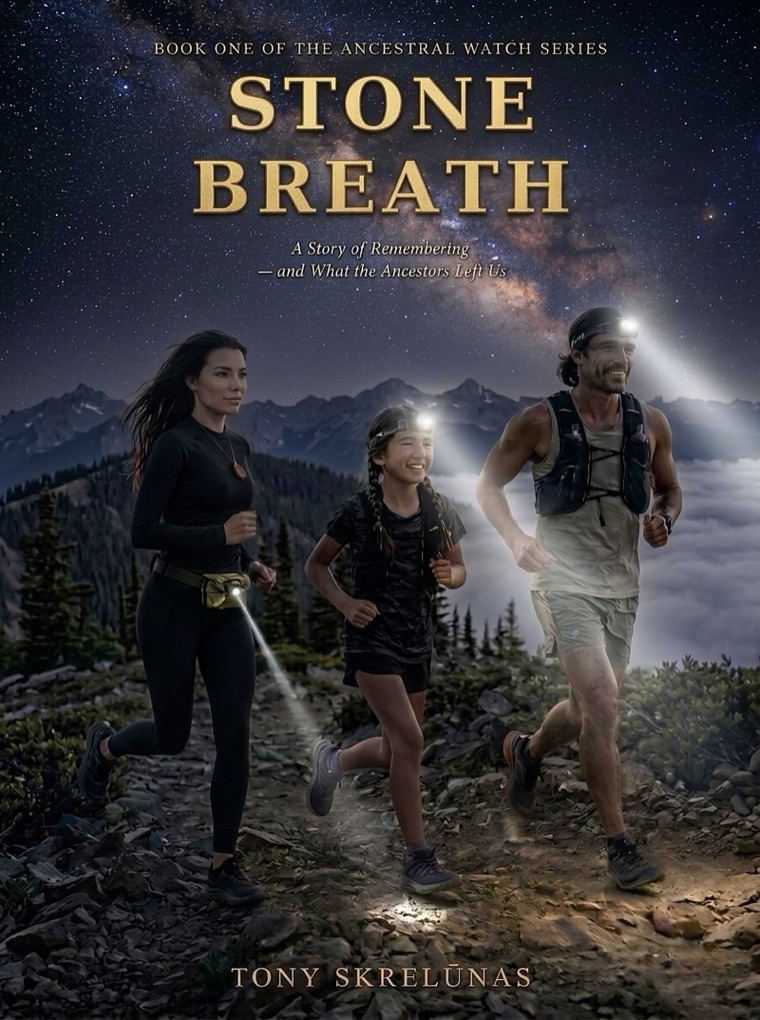
Stone Breath · A Stone for Your Hand
Before you read a word of the story, I want to put something in your hand. Find a small, smooth stone — the kind a river leaves on its bank. Not a metaphor. A real stone, in your real hand. If you can't find one tonight, close your eyes and picture one in your palm — a stone you remember from some trail or shore, or one you invent. The body believes a vivid picture.
Hold it. Feel its weight. Notice what happens as you do — the jaw softens, the cheeks let go, the face relaxes. That release is the first medicine. The old runners of my people imagined a stone resting on their tongues. The image of it — held still, steady, unmoving — kept the breath even and the panic down on the long road. The stone itself was always in the hand. The tongue was imagination: a mental anchor, a way to steady the breath without putting anything in the mouth. They ran twenty miles with it, and they ran home, and they passed it down, hand to hand, for longer than there have been cities.
Now do this. Breathe to a slow count:
In — four, light and easy.
Hold — four.
Out — six.
Hold — four.
Run the cycle five times. About a minute. The stone is an anchor, not a rule. Your heart rate settles. The noise in your head drops a notch.
Keep the stone close while you read. The stone is warm. You are not alone.
Stone Breath · The Arrival
He came off the small plane into a green he had no word for. His country was red — red rock, red dust, a sky so wide it made a person quiet. This place folded close and dripped: pine and black earth and a river somewhere, always a river. Under his arm he carried his grandfather's book, wrapped in the storm-pattern blanket the way you carry a thing you are afraid to set down.
She was waiting by an old car, and the first thing he noticed was that she was not waiting the way people wait — not checking a phone, not performing patience. She simply stood, whole, a rough piece of amber at her throat catching what light there was. When she looked at him she did not look him over. She looked at him the way his great-grandmother used to, from ten thousand miles and a whole life away, and something in his chest that had been clenched for twenty years let go a quarter of an inch.
“You've come a long way,” she said. “You look like a man who has been running.” It was not a question, and it was not about the trail.
What she would hand him back, in another language, on the other side of the world, was the thing he had been raised inside and had spent his whole success forgetting…