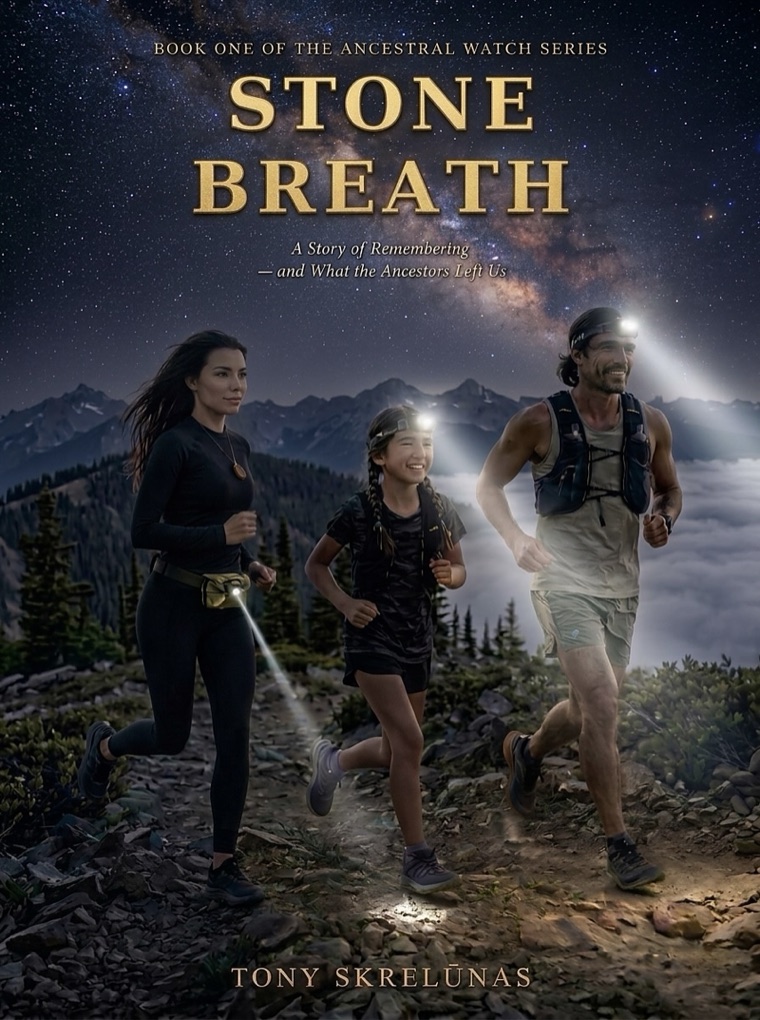
Book One · Stone Breath
The story of Stone Breath
A man who had everything, a book of old songs carried home to a Lithuanian village, and the woman who chose him.
Told by Tony Skrelūnas
Stone Breath begins in the red-rock country of Sedona, before dawn, at the bottom of a canyon, with a man named Tonas Yazzie leading eleven strangers down by headlamp. It ends up a long way from there, in a Lithuanian village of wooden houses and a stone mill on a river whose name means holy. The road between those two places is the whole book.
Tonas is Diné and Lithuanian, raised by his great-grandmother Masan on Big Mountain among four hundred sheeps. He has built the life that looks right from the outside, a master’s from Hitotsubashi in Tokyo, a global consultancy, keynotes in Geneva and Tokyo, rowing on the Tama River at dawn. He can teach a canyon full of executives to face what carved them. And still he has felt a small drift in himself, the dawn run turning into a workout and the breath into a technique.
Then his Lithuanian grandfather Vytautas passes, at the end of a long and good life. He built his own motorcycles and raced them up hills into his seventies, and he flew to Arizona every year to sit with a grandson on the far side of a continent. He leaves a small worn book of dainos, the old songs, carried across a border generations back, when the language itself was banned. He had asked Tonas to bring it home.
So Tonas carries it, wrapped in a storm-pattern blanket his grandmother Ada wove, on a bus out of Vilnius toward a village called Antalieptė, holding it on his lap with both arms. Austėja sees him before he sees her, from the window of the heritage center in the old mill. She is thirty. She runs the forest ridge before the sun every morning, and she has run 5k races across Europe in under seventeen minutes.
She helps the national basketball team with their footwork and their nerves, keeps the village archive and its songs, and is raising her daughter Ugnė in her grandmother Ona’s house, with the stove and the forest at the door. I wrote her as the one who was already whole when he got there, and the page that introduces her, Before We Begin, says it in two lines. “She doesn’t need him. She chooses him.”
Then come Ona’s letters, in the chapter called Fifty Years of Weather. For fifty years Vytautas wrote to her from Oregon, across an ocean and past a government, and mostly he wrote about the weather, so that a woman who never set foot in Oregon could tell you what November does there. Tonas asks why the weather. Austėja answers him. “Because you cannot censor the weather.” That is the kind of homecoming this is, a family keeping a door open for eighty years with handwriting and snowfall.
What follows is the slow work of a man learning to stay. The heritage center roof comes down one night and Austėja calls a talka, and forty-seven people come with tarps and coffee and bread. At the village meeting everyone talks at once, one of them about a fence that came down in 1991. Then Ona bangs her cane on the floor, and Tonas asks four questions and listens.
He plans a first date to the last detail and begins it face-first in the ferns. She calls it romantic. Ugnė, eleven, asks hard questions and then asks for the stone. And two grown people fall in love the way grown people do, with their eyes open, bringing their families along, by way of Kyoto and the red rock of Arizona and a mountain race by headlamp in the Alps.
That is what I mean when I call this a book about healing across generations. In the first chapter Tonas teaches his circle that what seemed to happen to the canyon was happening for it. The rest of the book turns that teaching on him. A grandfather’s songs, fifty years of letters and a great-grandmother’s practice all arrive in one man in the season he is ready for them.
The thread between a desert and a forest is my own family. My Lithuanian grandfather lived a continent away my whole life, and there were letters, and there were visits where hardly anyone shared a language and it did not matter at all. The Japanese thread came to me by kerosene lamp, in books that arrived by mail on a mesa with no electricity. The stone came from Masan, who had it from her father. I was handed all of it, and I am handing it on.
The free chapter below is Chapter One, The Canyon Within, the retreat in Sedona and the news at the end of it that sends him across the ocean. Chapter Two, The Box He Carried, is free on the next page, and that is where the bus pulls up by the mill. Read them both here, or press Listen and let them be read to you.
Read the first chapter free.
Listen · 20 min
20:17
Chapter OneThe Canyon Within
“What appears to happen to you is happening for you.”
“How you do the small thing is how you do everything.” — Japanese teaching
“My grandfather said the ancestors watch over us. My grandmother said they’re probably just waiting to see what mess we make next.” — Tonas Yazzie
Every one of them had built a life that looked right from the outside. That was the thing the circle had in common — nine executives and two who were not, gathered from wherever in the world they had made their names. A woman who ran a fund in London. A founder from São Paulo. A man from a Tokyo trading house who was used to a car and a driver and a floor of people who moved when he moved. A software chief out of Lagos. And sitting among them as equals, a schoolteacher who had emptied a modest savings account to be there, and a young man barely out of his twenties, barely out of harder places than that, who had paid nothing at all.
Tonas ran the program himself, once a year. It was an international leadership retreat he had built inside his own company, and it was the truest work he did. Most of the seats went to people who could pay a great deal for them. But he always held a couple open for people the room would otherwise never include, and he asked nothing for those seats but readiness. The code belonged to everyone, he figured, or it belonged to no one.
Because money was never the filter. There was only one filter, and it had nothing to do with what you could afford or where you were from. You had to want it. You had to be tired enough of your own dark to be willing, at last, to turn and look at it. The CEO and the schoolteacher and the young man from the hard place were in that circle for exactly one reason: every one of them had finally shown up wanting.
He had brought them to Sedona because Sedona was home. Not a venue he flew into — the place he had made his life, on a dirt road close to Oak Creek. He came from a big family, the way Diné families are big — cousins and aunts and uncles scattered across the whole region — and he had chosen this ground on purpose, for reasons that had nothing to do with how beautiful it was and everything to do with how it held a life together. It sat at the center of everything that mattered to him: a couple of hours from the rez, from Ada, from his parents; an easy run down to Phoenix and the city and the airports that carried him out to the world and home again. And it was the one patch of earth where, since he was a boy, he had always performed at his best. It gave him every kind of training a body could ask for, all within reach of the same front door: the high country and the mountains when he wanted altitude and climbing, the gyms in town when he wanted iron and structure, and — when he wanted the truth — the exact canyon trails that had forged that 4:20 mile as a boy, ground that already knew how to make him fast. Most people spend a life looking for the ground that makes them more themselves. He had found his early, and never let it go.
The Land, First
Before anything else, he honored the ground. He always started there.
“We are in the beautiful sacred red-rock country of Sedona, Arizona,” he told them, that first morning. “And before we take one breath together, we honor this land. These red rocks are the homeland of the Yavapai and the Apache, and of the Sinagua who came before them — the ancestors of today’s Hopi. And this canyon country was never one people’s alone. It was a crossroads. The trade routes ran through here for thousands of years, and many nations met and traded on this ground — the Hopi, the Navajo, the Ute, the Paiute, and more. We begin by thanking the people whose home this is, and always was.”
He did not do it because it was expected. He did it because it was the first tool. Before you can settle a single nervous system, you have to remember you are a guest on something older than you — and so is everyone sitting beside you. That is the whole book, said in one gesture, before the book begins.
The Descent
He took them down before dawn. On purpose. Everything about the three days was ordered on purpose — the way you would descend a real canyon and climb back out carrying water. Down first, into the dark and the depth, before you were allowed anywhere near the light.
They went single file behind his headlamp, breathing harder than any of them had breathed in twenty years and, for the first time in longer than that, not in charge of a single thing. Halfway down, the man from Tokyo stopped, hands on his knees, and made a sound that was half laugh and half despair.
Tonas went back to him. He did not offer a hand. He reached into his pocket and took out a small, smooth stone, worn round by the creek, and pressed it into the man’s palm.
“Hold this. Breathe into it — in through the nose, out long and slow. You are not dying. Your body just thinks you are, and there is a difference.” He waited while the man’s shoulders came down off his ears. “Before we look at anything you have been carrying, your body has to believe it is safe. That is not the warm-up. That is the work. You cannot reprogram a mind that is running for its life.”
The man breathed. Something in him unclenched. They went on down.
Reading the Walls
They reached the canyon floor as the first gray began to bleed up the walls, and Tonas stopped them there, in the cool blue dark at the bottom of a hundred million years, and had them look up.
“People spend their whole lives at war with their own canyon,” he said. “Ashamed of the marks. Trying to fill them in, or hide them, or pretend the storm that carved them never came. But look at what did this. Wind. Water. Time. Floods that must have felt like the end of the world when they came through. Every mark on this wall is a thing that happened here — and every one of those things was carving the exact shape that can now hold a river. Hold life. Hold you, standing in it at dawn.
“What looks like it happened to this canyon,” he said, “was happening for it.”
Nobody spoke. Somewhere up the rim a canyon wren spilled its long falling note and went quiet.
“That is why we came down first. Not to fix you — nothing is broken. We came down to read the walls. To turn around and look at the thing you have spent years running from, and ask it a different question. Not why did this happen to me, but — what were you carving? What are you here to teach me? The day you stop fighting your canyon is the day the marks stop looking like damage and start looking like formation.”
Then the sun came over the rim, and the whole gorge caught fire — red rock lit from the inside the way it only ever is in that first minute — and eleven people who had spent fortunes trying to find the off switch on their own minds stood in the light and forgot, briefly, everything they were so sure they already knew.
One of them was crying. Nobody minded.
Three Threads
That night, up on a bench above the creek, with the stars poured thick across the black and a fire going, the circle asked him what circles always eventually ask.
So who are you?
And Tonas told them the way he told everything — he had been telling stories since he was a boy — as a story.
“I’m three people,” he said. “I always have been.
“I’m Diné — Navajo. My great-grandmother raised me on Black Mesa, in a hogan with no electricity, and she taught me to run before the sun with a stone. Not as a ritual — as engineering. A way to keep the breath calm when the body wants to panic. That’s the first thread.
“Her name was Masan,” he said. “She was sixty-four when she took me. That is not an age at which a woman goes looking for a small boy to raise. She did it anyway, and she did not present it as a sacrifice, and I did not understand until I was thirty that it was one.”
He let that sit.
“Everything I am going to hand you this week came out of her hands. The breath. The morning. The way you sit with someone who is struggling and do not rush them. She had no framework for any of it. She would not have known what a framework was.” He looked into the coals. “She called it Tuesday.”
Somebody laughed.
“I want to be accurate about something, because I am going to be teaching all week and you should know where it comes from. I did not learn this at a university and I did not build it in a lab. I learned it from one woman on a mesa who could not read English, and every single thing I have tested since has held up.”
“I’m Lithuanian. My grandfather’s people were craftsmen who kept their traditions alive through a Soviet occupation that would have preferred they forget — fifty years of letters and songs carried through the locked door of a country. That’s the second thread.
“And the third I chose. I’ve spent my life apprenticed to Japan — to the idea that mastery is a spiritual discipline, that how you do the small thing is how you do everything.
“Three peoples who never met, on three sides of the earth, and every one of them worked out the same handful of tools for staying human under pressure. I didn’t invent any of it. I just happened to be the crossroads they all ran through.”
Someone asked what his people had been, before.
“Rich,” Tonas said.
The woman who ran the fund in London looked up.
“I’m serious. There’s a movie — Crazy Rich Asians. My cousins and I watched it and laughed for a week, because we kept thinking somebody should make Crazy Rich Natives and set it in 1650.” He turned a stick in the coals. “I am fairly sure that is what Columbus thought when he showed up. He was not looking at poverty. He was looking at wealth he did not have a word for.”
“What did rich look like?” the schoolteacher asked.
“Up before the sun. Every day. Without exception. Knowing the songs. Ceremony on the calendar and organization in every part of the life. Discipline in the work, the food, the body. The finest corn and the finest rugs, made by hand. Jewelry that took a winter. Fine horses. Sheeps — we say sheeps, do not ask me why. Enough food stored that a bad winter was an inconvenience and not a catastrophe.” He paused. “And a crew. Anyone actually rich had people working alongside them, and those people ate.”
He looked around the fire.
“And here is the part that would not survive a movie. You were only rich if other people were carrying the same knowledge. If you were the last one who knew it, you were not wealthy. You were a museum.”
Nobody said anything for a moment.
“How long were your people there?” the man from Tokyo asked.
“Depends who is counting. When I was a boy the scientists said a few thousand years. Then ten thousand. Then fifteen. Then thirty. Lately one or two of them are wondering out loud whether some of us started there.” He shrugged. “Our elders find this extremely entertaining. We have had the same answer the entire time. Since time immemorial.”
“And?”
“And we are not in a hurry. We have been right for a while.”
“And the art,” he said. “People say crafts. It is not crafts. There are weavers from that mesa whose rugs hang in museums on three continents. There are silversmiths whose work you would recognize on sight and could not afford. Painters. Potters. Carvers.”
“Why does nobody know the names?” the woman from London asked.
“Some people do. But most of them never called themselves artists, because there was no such job. You wove because the family needed a rug and because you were the one who could see it before it was there.” He turned the stick again. “World class, and nobody hung a sign.”
He was quiet a moment.
“And here’s the strange part. I knew I belonged to more than one place before I ever left that mesa. My great-grandmother had a table she was proud of, and a lamp on it, and by that lamp I read books that had traveled from Switzerland, from Lithuania, from Japan — the whole world climbing the mountain to find one boy, an envelope and a paperback at a time. I got so good at carrying stories that when it came time to stand up and tell one, I was the one they called on. A kid from a hogan with no power lines for miles, telling the old stories into a television camera while the whole community watched from the chapter-house TV.”
The schoolteacher laughed softly. The young man did not take his eyes off him.
“That lamp is the reason I’m standing in this canyon with all of you,” he said. “The teachers at my little community school saw a boy who was too much — too well-read, too well-dressed for a mesa kid, too steeped in the old ways and too sharp from all that reading, somehow both at once. And instead of clipping him, they went to my great-grandmother and said: he needs a bigger challenge. A place where he won’t have to fight just to be himself.”
Twenty Minutes Down the Road
That place was twenty minutes down the road.
Montezuma sat in Cottonwood, under Mingus Mountain, in the same red country he was showing them now — a working ranch as much as a school, where a boy grew his own food and mucked his own stalls and ran the canyons at dawn. And the thing nobody expected, least of all Tonas himself, was that it never felt like leaving. The chores, the animals, the plain daily responsibility — he had loved all of it already, up on Black Mesa, at his great-grandmother’s side. He simply carried the same self twenty minutes down the mountain and set it loose in bigger country. He came to know that country the way you only can by living and working in it — every fold of the red rock, the creeks, the climbs, the odd trip out toward Phoenix — knowledge earned in the body, mile by mile, over years.
He ran a 4:20 mile there as a ninth-grader, one of the fastest in the country for his age. The truth he rarely told anyone was that the race was not won on the track. It was won in the ten thousand dark mornings before it, with a stone in his pocket and his great-grandmother’s voice in his ear.
This land is one of the places the earth keeps its power, she had told him once. A meeting place. Small peoples lived here, and the world has always come looking for it.
He looked around the fire — Tokyo, London, Lagos, São Paulo, a schoolteacher, a young man learning for the first time what it felt like to be believed in — and he thought: she was right. The world still comes looking.
But there was a shadow under all of it, and there always would be, and he did not say all of it out loud.
Because in those same years — while he was becoming the fast kid at the good school, running this beautiful country at dawn — his family lost theirs. The traditional land on Black Mesa slipped away from them, the way it slipped away from so many Diné families, and his great-grandmother, who was that land, had to be moved off it — closer to the city, near his uncle and his mother, part of her time at Ada’s. The woman who had seemed as permanent as the mountain, pulled off the mountain. He was gaining a world in the very season his own people were losing one. He had spent the rest of his life learning to carry that. And it was the deepest reason he could stand at the bottom of a canyon and teach a circle of strangers to turn and face what carved them. He knew what it cost. And he knew, better than any of them, that the canyon does not ask your permission before it makes you.
The Harvest
You never leave people in the depths. So he lifted them back up out of it, because the other half of overcoming is gladness.
There was a feast they made with their own hands — blue corn and juniper ash and old knowledge carried down and nearly lost. There was a man with a bundle of flutes from half the world who lifted one to his lips and let the sound move through the circle the way water moves through rock. There was singing, and a slow round dance under the stars, and eleven nervous systems falling into rhythm with one another until something in each of them remembered what a whole successful life had made them forget — that it was never meant to heal alone.
A fire you gather around to decide who you’re going to be. His people had a name for that. He did not say it out loud. Not yet.
The Call
He banked the coals long after the others had found their tents, and sat with the last of the heat, and felt — as he always felt out here — entirely at home. The calm he taught. The excellence he taught. The belonging he taught. All of it real, and all of it his, right here on the ground that made him.
His phone lit up in the dark. A country code he rarely saw.
His grandfather had passed. In his eighties, at the far end of a long and good life — a craftsman who built things with his hands until his hands were done, who kept his songs through everything a century threw at him, and who let go the way a full life closes: not a tragedy, a completion. They had already had the service. There was nothing to rush toward and nothing to fix. There was only this, arriving quiet and steady across an ocean: the songs were his to carry now.
He sat with it, and he felt no grief so much as weight — the good weight of being handed something. Here was the thing he had never quite let himself see. He had stood at this fire and named three threads with pride, and one of them he had touched the least. He could teach a canyon full of strangers to stop running from their own lives, and he had spent his own at a careful distance from the half of him that was now, suddenly, his to carry. There was a box of fifty years of songs in a green country he had never once set foot in. And there was no one left to carry it but him.
He looked at the red rock he knew in his body, and he thought of a country he had never seen, and a grandfather he would now meet only in what he left behind. And for the first time in a long time, the man who taught others to turn and face what they were running from felt himself, gently, being turned.
He let the fire go down.
Somewhere on the far side of the world, a bus was running north through birch and pine toward a village he could not yet picture, and he was going to be on it, the old songs in his pack.
The day was already walking.
Next: Chapter Two, “The Box He Carried” →
The whole chapter — free
Read Chapter One now
The full first chapter — "The Canyon Within" — beautifully set, cover and all.
Read it by lamplight →Want new chapters, tools, and essays each week? Leave your email — one note, no noise.
Or buy the whole book direct ($16.99) →
“Guides readers toward a deeper sense of belonging, purpose-driven action, and the courage to live from inner knowing rather than fear.”
“Each chapter reminds us that the tools for endurance, belonging, and purpose are not lost, they are dormant. This book awakens them.”
“Honors the Lithuanian thread — the forest, the songs, the endurance — with the precision of a native, not a tourist.”