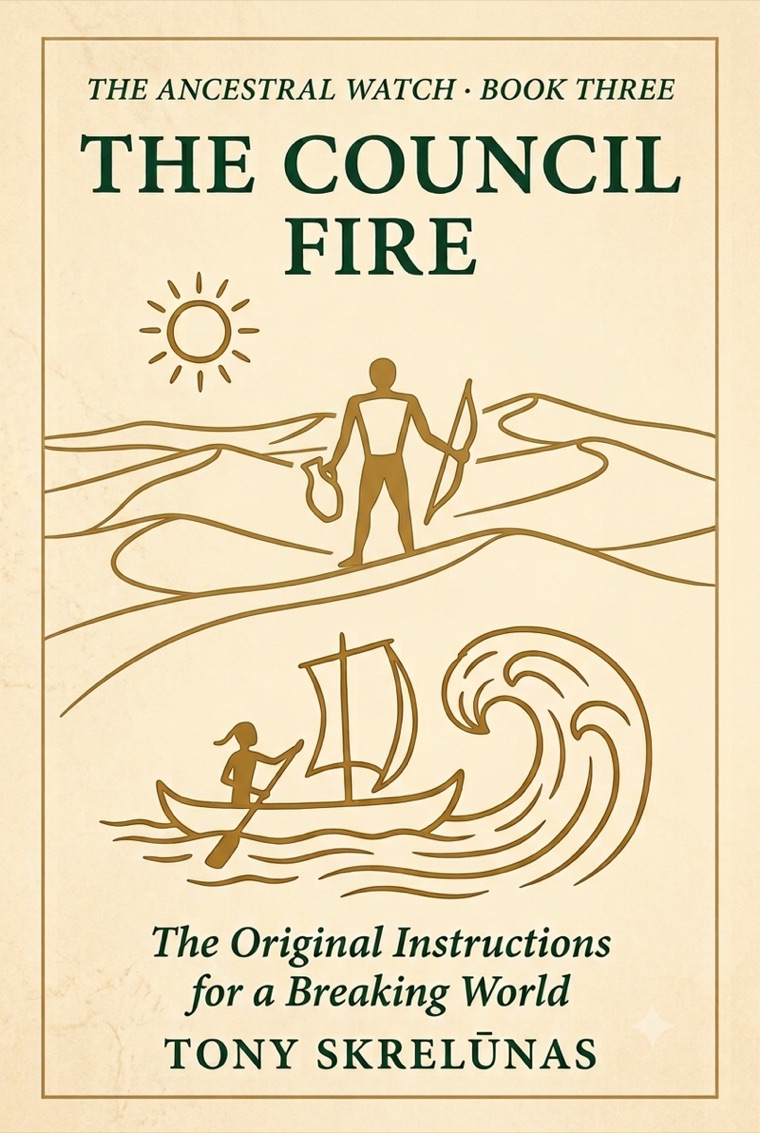
Book Three · The Council Fire
The story of The Council Fire
Twelve keepers on six continents, and the chapter where each of them tells the crossing in their own voice.
Told by Tony Skrelūnas
This book began with a dream that kept coming back to me. I was led into a great round room under a starry sky and given a seat among the ancestors, dry farmers and reindeer herders and navigators and the keepers of deserts and forests, with scientists and engineers sitting among us as listeners. What I was shown, every time, was the rebuilding. The fire was already lit, and the room was full of people who had come through.
That is why The Council Fire has twelve people in it instead of one. They are keepers on six continents, and most of them had never heard of the others until a letter arrived. Käthe keeps the water under the old coal country of the Ruhr. Ugnė keeps the Lithuanian songs that need three voices. Illary carries her seeds up the Andes ahead of the heat, and Nizhoní holds the high desert of the Navajo Nation.
Beside them sit Aoi from Japan, Vahan from the Armenian highlands, Lobsang from Tibet, Te Rangi from Aotearoa, Warrun from his songline country in Australia, Kiprono from the Rift Valley, Hamish from the Scottish Highlands and Chariya from the rice terraces of Thailand. Each one carries a small thing from home, a lump of coal, an amber bead, a river stone, a rice seed. At the end of the book a child holds all twelve.
The book moves the way a long telling moves around a fire at night. First what broke, then the keepers one by one, then what they built on the far side of it, the circles and the ledgers and the pact they set ahead in time for great-grandchildren they would never meet. Last comes the well world a hundred years on, where the question from my dream is carved over the door of a round room.
If a friend asked me for one chapter to understand the whole book, I would hand them The Cascade. It opens Part Four, after all the building, and it is where the twelve tell the crossing itself. The narrator says the numbers were kept the whole time, measured and published and filed. They did not move anyone. So the record is told the old way instead, as tellings the keepers carried from gathering to gathering for the rest of their lives.
Käthe stands in her kitchen with the river in the street, thinking about the water six hundred meters down in the old mine workings that has to be pumped forever, and she telephones the office, on a Sunday, in a flood. She gets the recorded message, which invites her to leave her name. She has told it at every fire since. “Eternity had begun and the answering machine did not know.” Kiprono, who had a name for each of his forty-one cattle, watches a young man from a ministry write nomadic in a little box. He lets it stand.
Lobsang watches the snow climb past a notch a monk cut in the granite four hundred years ago. Te Rangi watches his cousins’ well go salt. Nizhoní goes door to door in the heat at four in the afternoon, and one elder makes her come inside and drink a glass of water in front of her. Illary’s grandmother listens for an hour to a talk about a seed bred for heat, and then asks what it tastes like.
I wrote them funny on purpose. The chapter tells you why. The keepers came home from those years dry and hard to impress. When one of them made a room laugh at the end of the worst hour of their life, that was the lesson itself, a person showing you that you can go all the way through and come out the far side still able to laugh. “The laughter was never the opposite of the calm. It was the calm, arriving.”
Then the narrator holds all twelve together and shows you the shape. Millions of ordinary families each decided, sensibly, on some ordinary Tuesday, to go. The places that held were the ones that still knew how to feed themselves, decide together and take in a stranger. And under all of it was a thing that came and stayed with no word in any language to name it, so people used the old words, and the old words made it small. “That is what the twelve broke. Not the heat. The silence.”
I wrote The Council Fire about healing what breaks between generations, and about how a people crosses hard ground and arrives whole. I wanted to work out how we light the far messengers again, and how the great-grandchildren, a hundred and two hundred years from now, come up into a world that still has the tools to build something better. When twelve peoples who never spoke arrive at the same answer, I count that as evidence.
The opening below comes before any of them. It is the first voice, a descendant seven generations down with all twelve tokens in hand, and then Prologue I, The Runners, our oldest grandfather running seventy miles across the high desert to carry what he had seen. Read all of it here, free, or press Listen and let it be read to you. The twelve are waiting on the other side of him.
Read the opening free.
Listen · 19 min
18:48
The Council Fire
first voice
A braid of twelve names from twelve corners of the world. They came down to me hand to hand.
My grandmother told me a person should always say who they are before they tell a story, so the ancestors know who is speaking.
So. My name is a braid of twelve names from twelve corners of the world, and I will tell you them at the end, when you have earned them. I am seven generations down from the people in this book. I am holding, as I write this, a lump of coal, an amber bead, a carved stone llama, a smooth river stone worn by many thumbs, a black go stone, a stone cross, a mala of bodhi seeds, a pounamu, a lump of spinifex resin, a beaded bracelet, a granite clan stone, and a rice seed—the tokens they carried, that came down to me. I live in a world they made out of the broken one. It is hard here, and it is good.
They left this record so we would know it had been done before. So that if it ever broke again, we would not be afraid, because we would have the map. They wrote it as a warning, for their own time, and as a map, for mine.
Both came true. I will let you decide which mattered more.
Twelve of them, on six continents, and not one had heard the others speak until long after. A water keeper in a German coal valley stood in her kitchen with the river in the street. A rice keeper watched the rain come at the wrong time and her brother get on a bus. A herder stood in the bed of a river that had run every year of his grandfather’s life. A monk watched the snowline climb past a notch a man had cut in granite four hundred years before. A navigator moved the boats, and then the houses, and then ran out of island. A woman in the high desert watched the heat come down like a lid over the brightest country on earth, under wires that carried nothing. A songline keeper lost a stretch of country and, with it, the map. A crofter watched the storms come one behind the other and felt a thing rise in him about the incomers that he is still ashamed of. A seed keeper carried her seed up the mountain until there was no more mountain. A woman who had helped build the machines watched what they did to the minds. A song keeper sang in a cold shelter with three hundred people and the power out. And an old man in the Armenian highlands read the signs arriving in their order, and was not afraid, and was not surprised, and was finally believed.
None of them had a word for it. That is the part to carry into this book. Every language they owned described something that comes and passes—a storm, a drought, a flood—and there was no word anywhere for a thing that came and stayed and kept coming. So they used the old words, and the old words made it small, and you cannot organize a people around a rough patch.
That is what the twelve broke. Not the heat. The silence. They found each other, and they made the words, and once there were words there could be a council.
This is what they did.
Prologue IThe Runners
The runners crossed the killing ground, and carried what the people needed.
Our oldest grandfather has no name anymore. The name wore off the way a stone wears smooth in the bed of a river, handed down through so many mouths that only the shape of it is left. But we kept his run.
And here is the thing to understand before he speaks, the thing this whole book turns on: he is not the grandfather of one people. He is the grandfather of all of them. The run you are about to follow happened in the high desert — but it happened, in the same shape, on every continent that ever held a people. Different skies. Different stones in different hands. The same run, and the same cargo.
Before there was a herder or a navigator or a song keeper or a crofter — before any of the twelve you will meet in these pages — there was this one figure, everywhere at once: the one who watched the world for longer than a single life, read the land like a face, carried what they saw to the people who needed it, and wrote it where it would outlast them. He carried no trade goods. He carried what he had seen, and that turned out to be the most valuable cargo there has ever been. He is the root. The twelve are his branches. And so are you.
This is the first instruction. He tells it better than I could, so I will step back and let him.
I run with a stone in my hand.
A small smooth one, river-worn, the size of a bird's egg. You learn it young: you close your fist around it and you picture it resting on your tongue, and the picturing alone brings the water back to a dry mouth, so the thirst does not own you; it keeps the breath even and slow; it holds the panic down when the legs are gone and the sun is high. My grandmother closed my fingers around my first one when I was small, and taught me the picturing. She called it a covenant: I carry it, and it carries me. The stone is older than me. It will be older than my grandchildren. I am carrying it seventy miles today, and I will carry it home.
I am not carrying anything else. No corn, no hides, no salt. People who do not understand us think a runner must carry something, or why run at all. But I am carrying the most important thing there is. I am carrying what I have seen.
For four summers I have watched the sky over the far country, the way my father taught me and his mother taught him. Understand: this is not idle watching. This is how a dry-land people farms. We cannot call the rain down, so we must learn—better than we know our own names—exactly where it will fall, and exactly when. One day tells you nothing; one day is a liar. You watch for years, until the years begin to rhyme.
And this is what four summers have told me. Between my mesa and the rim of the world lies a wide valley, the better part of a hundred miles of open country, and at the very edge of seeing stands a blue mountain that none of our people live under yet. In the moon when the ground first warms, the wind sets in from the great water none of us has seen, and it carries the wet in low and stingy and gives us nothing as it crosses. But it does not wander. It runs the same road every year, straight for that mountain, and the mountain reaches up and combs the wet out of it, and the clouds pile against its shoulder and let go. I have lain on my back through whole afternoons and watched rain fall on that far shoulder when there was not a drop anywhere else in the world. That knowing is worth more than any field—because that knowing is how we choose the field.
And our own place—the place I was born, the place my mother is buried—is tiring. The corn comes up shorter every few summers. The springs come up later. And the clouds that once gathered over our own fields have been sliding, a little each year, toward the foot of the blue mountain, the way the sky pulls away from a land that is ready to rest. That is the surest sign of all. So I am running to tell the others that the next place lies across the valley, under that mountain, where the rain has gone to live.
But a run like this is not a thing you begin on the whim of a morning. You prepare for it the way you prepare for a ceremony—because it is one.
First I carried what I had seen to the elders, and we sat in council over it a long time, days, while they turned it the way you turn a stone to see all its faces. They asked me questions I had not thought to ask the sky. They remembered runs from before my father’s father’s time—what those runners found, and what it cost them—and they weighed my four summers of clouds against all of it. Only when they were satisfied that the thing was true, and could not wait, did they agree the run must be made. And even then they did not simply send me. They made me ready.
It took eleven days. I was twenty-three and I thought I would come out of my skin.
I understand it now and I did not understand it then, and I want to say this to any young one who is certain and in a hurry: they were not being slow. They were finding out whether I had seen a thing or whether I had wanted to see a thing, and from the inside those two feel exactly the same, and only time pulls them apart.
On the ninth day my uncle asked me, mildly, what the clouds had done in the summer I was sick.
I had not watched that summer. I had said four summers and I had watched three.
That is why it takes eleven days.
Four days in the sweat, in the low dark house of bent wood and hide, praying and enduring and emptying out, sweating off the soft season—the easy food, the lazy breath, the small fears that sit in a man and slow him. And in the dark behind my eyes I ran the whole road, again and again, every wash and shelter and climb of it, until my body knew the seventy miles before my feet had touched a single stone of it. I put down the heavy food and ate parched corn and seed and a little dried meat, so that out on the road my body would not betray me by crying for what it could not have. And last I chose my stone, and the elders prayed over me, and the morning came.
I will say plainly that parched corn is not good. Nobody has ever claimed it was good. We have a song in praise of very nearly everything we eat — there is a song for the first beans, and one for water, and one for a particular fat bird — and there is no song anywhere about parched corn, and I do not believe this is an oversight.
Only then did I run.
Seventy miles is not far if you know the road, and I know this road the way I know my own hand—because the road is written.
Not by our feet alone, though the runners before me have polished the rock smooth in the narrow places. It is written on the walls. At every shelter where a person can rest and drink, the ones who came before pecked the knowing into the stone, so it would outlast them, so it would outlast me. People who do not understand think the marks are only pictures—a spiral, a deer, a row of handprints. They are not pictures. They are the instruction. The spiral tells you the water there moves in a circle through the year, full in the cold moons and gone by the hot ones, so do not come thirsty in summer. The deer above the second wash tells you the moon the deer come down it, and that is when you take one, and not before, and not the doe with the heavy side. The handprints are the names of the ones who kept this stretch of road, signing their work the way I will sign mine, so that a hundred and fifty years from now a runner can lay his own hand in the worn print and know he is not the first, and will not be the last.
My cousin, who is not a runner and has never claimed to be, once asked why we do not simply write do not take the doe with the heavy side. I told him we did. He asked why it looked like a deer instead of like words. I said it looks like a deer because it is about a deer, and he said that in that case the wavy line ought to look like water, and I said it does, and he looked at it for a while and said, so it does.
He has never once got lost. I want that noted, because he tells the story differently.
I read the walls aloud as I pass them, the way you greet relatives. Here is the place where, if you clear a forearm of dry sand from the low side of the wash, you reach water that never leaves the ground even when the sky forgets us for a whole year—marked with the wavy line beneath the flat line: water, below, always. Here is the spring under the ledge, where a stranger could die of thirst leaning against it. Here grows the gray-leafed plant that keeps a wound from going bad; here the root you chew for the fever of the wet moons; and here, marked with the broken line, the pretty one that looks like food and is not.
And the cycles—which are the most precious knowing of all, because a single life is too short to learn them once and far too short to learn them twice. Plant when the snow leaves the third peak, not the first peak, the third, or the late cold will take your seedlings. When the red ants carry their hill higher, the water is coming; move your camp up out of the wash. And be careful—be careful—of the wash that floods under a clear blue sky, because it rained on a mountain you cannot see, and the water comes down the dry channel like a brown animal, faster than a man can run, and takes the ones who never learned to read the wall that warned them.
I sing as I run, and not to pass the miles. The songs are instruction too—the kind that lives in the breath instead of the rock. The song that calls the water holds, in its order, every place along this road where water can be found, so a person singing it cannot get lost and cannot die of thirst, because a song is a map you can neither drop nor burn. There are songs that teach the watcher which shapes of cloud mean rain by nightfall and which shapes lie. And there are songs for the body on the long run and for the body in its last quiet hours both, that slow the heart when it wants to bolt and steady the hand when it shakes. I sing them because they are true, and because a man alone on a long road is not alone if he is singing what his grandmothers sang on this same road, looking at this same mountain.
I come down to the testing ground in the last light, the blue mountain standing close and huge now, my legs gone to wood, the stone still in my fist.
They are there, the ones who went ahead, kneeling in soil darker than ours, and deep. They put in the corn and the beans and the squash to ask the ground a question, and the ground has answered while I ran: the seedlings are up, green and certain, in earth that has never grown our food before. They take me to the wash and we clear a forearm of dry sand from the low side—the way the walls upcountry taught us both, though we learned it a hundred miles apart—and the sand goes dark, and then wet, and then our hands are in water. In the dry moon. With no cloud in the sky.
I tell them what I have seen. Four summers of clouds going to the mountain. The wind off the far water, and the mountain combing it. They listen the way you listen to someone who has carried a thing a long way to put it in your hands. And we know, all of us, kneeling there with our hands wet, that this is the place—that when our old home lies down to rest, the people will come here, and the children not yet born will believe they have always lived here. Until one of them learns to read the walls, and finds out how they came.
Before I run home, we add to the rock. We peck the blue mountain, and the line of the wind, and the wavy water-line under the flat ground-line: water, below, always. We lay our hands flat against the stone and blow red earth over them so the prints will stay. For the ones who come after. For the great-grandchildren, whoever they turn out to be.
That is our oldest grandfather. Yours and mine both — whoever you are, wherever you are reading this. Go back far enough up anyone’s line and you arrive at him, and everyone in the pages after him is running his race: the woman keeping the dark water down, the girl who would not let the sun be stolen twice, the monk coming down the failing snows, the navigator, the herder, the rice mother. All of them laying a hand in the worn print and finding out they are not the first, and will not be the last.
That is the first instruction, and it is the same as the last one, and the same as all the ones between, in this whole book. Watch the world for longer than your own life. Carry what you see to the people who need it. Write it where it will outlast you. And run.
And he was not alone on the earth that morning. As he came down off the pass in the first light, a runner of the high Andes was moving along a stone road above the clouds, a cord of knotted wool in his fist, carrying the harvest count between valleys. In the far north, a herder was out ahead of the reindeer on the crusted snow, reading the ice the way the runner read the clouds, deciding whether the whole people would move. On a red desert older than memory, a walker was singing the water-holes in their right order, carrying the map in her breath. On a warm sea, a navigator was reading the stars' road home with no instrument but the memory of her teachers. None of them knew the others existed. All of them were making the same run.
They ran so that we would know it could be done. All of us. Together.
One more thing about him, and then we will go on.
Every people that raised crossers also produced, without fail, the other kind — the young man who has decided that the training is superstition and the old way is slow and he personally will simply go faster. Every single people. It is apparently a fixed feature of human beings, like the spine.
The records of those peoples are unsentimental about this fellow. He is in the songs of half a dozen nations and he is never the hero; he is the cautionary verse, usually short, usually placed where the children are still awake. And the joke is always the same joke, in every language, which is its own kind of evidence: he did not fail because the desert was cruel. He failed because he was in a hurry, and the desert does not care how urgent your errand is.
Now let me tell you how it broke—and how we put it back together with gold.