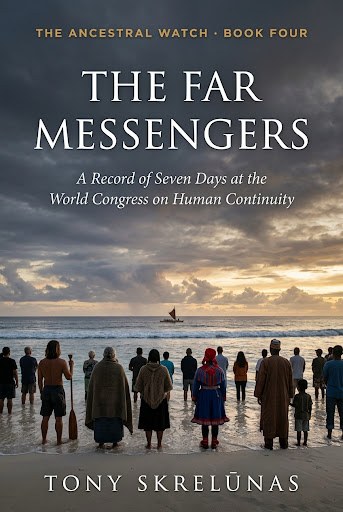
Book Four · The Far Messengers
The story of The Far Messengers
Seven days in a Swiss valley where the ice used to be, and the song keeper and the navigator who met there.
Told by Tony Skrelūnas
The Far Messengers happens in one week, in one valley, and I want you to see the valley first. It is Interlaken, in Switzerland, in the first week of September. The village was built for winter, with hotels that used to be ski hotels and a cable car that still runs on schedule, empty, up to a station that was once the middle of a glacier. The sign at the trailhead says Glacier Memorial Walk.
That is where I put the World Congress on Human Continuity. Two hundred and forty people came, by train and by ship, to talk about the end of a world. The book is the record of those seven days, put together from the proceedings, from three broadcast recordings and from what the people in the room sent in afterward.
You hear Wanjiru Odhiambo-Kariuki, the Kenyan scholar who chose this valley when four governments wanted Geneva, open the Congress at dusk. She does it outside, in the cold, with no microphone, so that two hundred people have to be quiet to hear her. She has invited two speakers by name onto the long-range track, the one that looks a hundred years ahead. Neither of them had ever attended anything like it.
Rasa Vaitkutė keeps the songs of Lithuania, the old ones in three voices that were kept alive through occupations, and she has crossed the desert on foot eleven times as her training ground. Nalu Kealoha-Nakamura is a navigator from the Pacific and a channel champion, a man who can find an island he cannot see by lying in the hull and reading the swell through his back. Each had written a book. They had never met.
They find each other on the first afternoon, in the registration line of a ski-hotel lobby, forty meters apart, because in a whole room of people braced for the next thing, they are the two standing still. On Day Two the whole Congress rides the mountain railway up at six and stands at the bottom of a glacier that is gone. The guide says the ice was sixty-two meters over their heads when he was at school. His father leads the memorial walk now.
That afternoon Nalu speaks without notes and gives the ministers the whole shape of a crossing, the loading, the long middle where nothing feels like progress, the bent swell, the beach and the grief and the hard, brave years after. He tells them about the first fire on a new island and the first words the navigator spoke there that were not a prayer. “The wind is asleep. Unload the children first.” Then he asks for three things, because a tired person can carry three home. The applause takes four seconds to come.
Rasa came over two mountain passes on foot at fifty-one, with everything she owns on her back, and The First Fire is hers. That night, on the terrace above the guesthouse, she tells the circle that every hard ground on earth wrote the same instruction. The sand wrote it, and the songs and the passes and the ocean: a slow heart, a counted breath, the fear held in the hand and set down. “Train the carriers. Everything else is cargo.”
I wrote this book about what happened to the human body in the last two generations. We built a world that keeps the alarm ringing from morning to night, and a body in alarm cannot take anything in. That is the block in front of nearly every good thing we try to hand each other. The far messengers are the ones who learned to settle that alarm on ordinary days, so they could carry what mattered across hard ground and arrive whole.
I want to be honest that the name is mine, my word for a role I found in every people I looked at. The Council Fire told what twelve keepers built, and this book is about the people who carry it. Look at the cover of The Council Fire and you will find the crosser of the sand and the crosser of the water drawn on the same page, unaware of each other. Here they share a room for seven days.
The week ends with nothing signed. Ninety-one years later a grandmother tells the girl who has found this book taped together in a cupboard that her own father went to a very large meeting once and nothing came of it, and that he laughed every time he said so. I will let you find out why he laughed.
What came of it was a list of hands carried home on paper, a working chant handed over on a railway platform, a river stone, and, at the end of Day Seven, two children on the platform who have known each other three days. Saulė asks Koa if he would keep one of her family’s songs. “Send me the hard one,” he says.
The opening below comes before the valley. It is the first chapter of each of the two books Wanjiru read before she invited them, hers about a man at a dry well in the Empty Quarter and his about an island that was not there. You meet them the way Wanjiru did, through their own pages. Read it here, free, or press Listen and let it be read to you. Then come up the valley for seven days.
Read the opening free.
Listen · 26 min
26:07
The Far Messengers
Before
from What the Sand Taught the Songs by Rasa Vaitkutė · Chapter One
On the fourth day, the well was dry.
He came down off the last dune to the place the water should have been, and the seep was cracked mud, pale, and there was nothing.
I am going to leave him there a moment, standing over the dead well, because you cannot understand what he did next until you understand where he was standing.
There is a desert in the south of Arabia that the people who lived near it called the Empty Quarter, because long ago they believed their land was the whole world, and they divided that world into four parts, and this was the part with nothing in it. Rub' al Khali. And they were closer to right than they knew, because it is the largest continuous sand desert on earth—six hundred and fifty thousand square kilometers, a single unbroken sea of sand larger than all of France, shared in the end by four nations that could agree on almost nothing except that nobody wanted to live in the middle of it. Dunes among the tallest on the planet—some stand eight hundred feet from base to crest, higher than the towers the modern world would later be so proud of. The sand is not yellow. It is red-gold, and it has iron in it, and at dawn and at dusk the whole desert catches fire, burns quietly for half an hour, and goes dark. I have stood on one of those dunes at sunset and said something out loud in Lithuanian that my grandmother would have pretended not to hear.
And it was not always empty. Dig into the hardpan between the dunes and you find the floors of ancient lakes. The bones that come up out of that sand are hippopotamus. Water buffalo. Long-horned cattle—great wet-country animals that grazed there when the desert was green, only a few thousand years ago. Then the rains moved, the way rains move—the way they are moving again, in our own time—and the lakes went to salt, and a country of grass became the great emptiness.
The people who stayed did not flee it and did not conquer it. They married it. They learned its wells and its stars and its winds the way you learn the moods of someone you will live beside your whole life. The great caravans went around that sand, because the middle of it was death.
These people crossed the middle. They were among the last human beings on earth who could.
The man at the dry well was one of the last of the last, and I want you to know how he got there, because the part the loud world always forgets is that the crossing was not made out on the sand. It was made before.
Days before he left, he put down the heavy food and ate light and clean, so his body would not cry out on the road for what it could not have. He counted his water and his salt and told them over, twice, the second time slower. He went to the elders and laid before them what he had seen, and the elders turned it over for three days—weighing his knowing against the crossings of men who died before his father was born—while he sat outside their circle being twenty-six and certain and saying nothing, which the ones who keep his story agree was the single hardest discipline of the entire crossing.
And every one of those readying days, he ran the whole crossing behind his closed eyes. Every dune-field. Every well. Every stretch of open death between the wells. Until his body knew the country before his feet had touched a grain of it.
He carried no map. He was the map.
By day he read the sun, and by night the stars, and when the dust came down and the sky gave him nothing, he read the sand itself—because the great dunes lie at an angle to the wind that built them, always the same angle, and a man who knows the wind knows which way he is facing from the shape of the ground under his feet. Think, next time your phone loses its little blue dot, about a man navigating six hundred and fifty thousand square kilometers by the slant of the ground in the dark, and be more patient with your phone. Or less patient with yourself. He would have suggested the second.
So. The fourth day. The dead well. Everything his crossing was strung on, cracked mud.
I want to stay in that moment longer than the story wants me to, because everything I have to say is inside it.
A frightened man does one thing here, and it is always the same thing. His heart bolts. He gets up and moves—fast, in some direction, because moving feels like doing. He runs in the heat and pours his own water out through his skin into the sand. And they find him the next morning a few hours' walk away with the panic still on his face, and the well he needed sitting half a day north of where he died.
This man did not do that.
He sat down.
I have thought about that for eleven years. Not the courage of it. Anyone can be brave once. It is the trainedness of it—that at the worst moment of a crossing, with everything in his body screaming, the thing he reached for was a practice he had rehearsed a thousand times on days when nothing was wrong.
The ones who keep his telling say the fear came and stood next to him immediately, the way it does, and began making its case. And the fear's case was excellent. The fear had figures. The fear had already worked out the hours of water left in the skin, the distance to the next known well, the arithmetic of his own sweat—the fear, they say, is always the best-prepared speaker in the tent, and the trick is to notice that it is always the same speech. He sat in the shade of the dune with death a day off in every direction and listened to the fear present its findings, and he is supposed to have thought—and this is in the telling, generations of it, so it mattered enough to keep—yes, and you said this at the second well also, and at the wadi when I was nine.
That is the interior of a far messenger at the worst moment of his life. Not emptiness. Not iron. A man noting, with something very close to amusement, that his terror repeats itself.
He softened his eyes to the whole horizon—not to search it, to widen it, because a narrowed eye is a frightened eye and a frightened eye reads nothing. He closed his fist around a small river-worn stone he had carried since the first morning and pictured it resting on his tongue, cool and smooth, which brings water back into a dry mouth by itself; I have done this and it works and I still do not entirely understand why. And he counted his breath the way he had been taught as a boy, to a rhythm like a slow drum: in for four, hold for four, out for six, hold for four.
He let the fear stand there beside him and gave it no chair to sit in.
That is the line I could not get out of my head. It is not mine—it is how his descendants tell it, and I heard it from a woman whose family has kept the telling. The fear is not the enemy. The fear is a guest who will stay as long as you keep offering it somewhere to sit.
And then his heart came down. And when it did, his quiet mind did the thing his racing mind could never have done.
It remembered.
A seep, half a day back and to the north, in a place no sensible person would look for water. His grandfather had mentioned it to him once—once—years before, in the way of a man who said everything once and considered repetition a form of doubt. It gave water only in the years the great rains failed everywhere else. This kind of year. The dry-well year. The telling says he sat a moment longer, checking the memory the way you check a knot, and that what he felt was not relief but something drier and more familiar: of course it is half a day backward. It could not be half a day forward. That is not the kind of story my family is in.
He got up. He went north. It was there.
And here is the part I love, the part that convinced me these were my people even though they are not my people: he laughed. Standing over a miserable brown trickle in the middle of the largest emptiness on earth, with two days still to walk, he laughed out loud, alone. Because among the ones who trained this way, the laughter was never the opposite of the calm.
It was the calm, arriving. The breath coming loose in a body that had decided to live.
He drank. He filled the skin. He rested in the shade until the sun went down. Then he went on, and his heart stayed slow, and the map stayed clear, and he crossed.
I am not from a desert. I am from a country of forest and lakes, and my grandmothers kept a very different set of things alive.
But I have crossed sand eleven times now, and I went the first time because my grandmother entered me in a race without asking and would not say why for two years. She handed me the letter with the entry number in it the way you hand someone a bill they have been avoiding. When I finally demanded a reason—two years later, after the second crossing—she was quiet for a while and then said: you sang like a person who has never been thirsty. And went back to her potatoes. My grandmother could close a conversation the way other people close a border.
The first time, I failed. Badly, at sixty kilometers, sitting down and crying while a very kind official squatted beside me and offered water I did not deserve. He had the professional tenderness of a man who has watched hundreds of foreigners discover themselves in the sand, and he said the only thing anyone said to me that whole year that helped. He said: you are not injured. You are only meeting yourself. Then he radioed my number in as a withdrawal, which felt, at the time, like being read my own obituary by a polite stranger.
What broke me was not my legs. It was the counting. How far is left. How much is left. Whether I could do this at all. That voice, for hours, in a country that gives you nothing else to look at.
And what I understood, sitting in that sand, was that it was the same voice that would not let me hold my line in the songs. The exact same voice. It had only ever been quieter at home because at home I had three jobs to drown it out. The desert has no jobs. The desert has you, and the voice, and eleven hours of daylight, and that is the whole program of events.
A frightened woman forgets her own name.
I went back to learn what these people knew, and their descendants—who owed me nothing—taught me some of it. I sat with the woman who keeps the telling of the man at the dry well, in her kitchen, over tea so sweet my teeth reported it to me for a week, and she watched me fill half a notebook and then asked, with a completely straight face, whether my pen ever got tired, or only its owner. And then she told me which parts of what she carried were not for me to carry away. She told me plainly, without apology, the way you tell someone which room of the house is not on the tour. I have honored that, and this book carries only what I was given permission to carry.
But the shape of it I was allowed to take, and the shape is this: you do not make the calm out there. You cannot. There is no calm available at the dry well, at the sixtieth kilometer, at the phone call in the night. You can only spend what you already stored, on days when nothing was wrong, in a practice that felt pointless at the time.
That is what the sand taught me.
And when I brought it home and stood in the circle again with two other women, singing three melodies that grind against each other on purpose—the one thing I had never been able to do finally happened.
It locked.
Which is the whole story of this book. The sand taught the songs.
from Reading the Swell by Nalu Kealoha-Nakamura · Chapter One
The island was not there.
That is where I have to start, because that is where they started, and everything else in this book is downstream of it.
But first you need the ocean, because without the ocean the whole thing sounds like a reasonable risk, and it was not a reasonable risk. It was the least reasonable thing human beings have ever done on purpose.
There is an ocean on the far side of the earth from everywhere that covers a third of the whole planet. Inside the great triangle of it—Hawaiʻi in the north, Rapa Nui in the southeast, Aotearoa in the southwest—there are more than a thousand islands scattered across sixteen million square kilometers of open water, a reach larger than Russia and Canada put together. The ratio of land to sea inside that triangle is about one part in three hundred and seventy. My teacher used to say the ocean is mostly water. He said it the way other men deliver philosophy, and it took me years to hear what he was actually saying, which was: respect the arithmetic.
To find an island in that expanse is to find a grain of sand thrown somewhere onto a floor the size of a country, in the dark, from a moving boat, with your eyes closed.
And a people found them. All of them. Every habitable island in that entire ocean was found and settled on purpose, by voyagers who sailed to it across thousands of miles of open sea with no compass, no chart, no instrument of any kind, and no written word. No other people in the history of the world crossed such distances of open ocean deliberately and lived to do it again. It is, plainly, the greatest feat of navigation our species has ever performed.
And it was done by the calm ones. Hold that. It was not done by the brave ones. I will come back to this, because the difference is the whole book.
Picture what you are actually asking a person to do. You are going to put your family in a canoe—your mother, your children, the seed stock, the animals, the whole line—and you are going to sail away from land that feeds you, into water that has no marks on it, toward something you have never seen and cannot prove exists. And you are going to do that on the word of one person.
And understand what the canoe was, because the loud world hears "canoe" and pictures a man and a paddle. This was a ship. Two great hulls lashed side by side, the deck between them—and it carried a world. Some of them carried eighty people across the open deep, and with the people the seed-plants and the breeding animals and the tools and the cuttings: everything a nation needs to step off onto empty land and build a life from nothing. The desert runner, whom you will meet elsewhere in these pages, carried his people's knowing across the sand. The navigator carried the people themselves. If he read the water wrong, they did not go hungry. They died, all of them, in the middle of the deep, and no one ever knew where.
That person did not have a map. There was no map, because a map is a record of somewhere someone has already been, and nobody had been.
What they had was a reading.
Birds that went out in the morning and came back in the evening, and the direction they came back from. A cloud that stands still while every other cloud walks—because something under it is holding it there. Green in the underside of a cloud where the water below is shallow—the lagoon reflecting itself onto the sky, so that a navigator could see an island's reflection before the island itself had climbed over the edge of the world. Drift. Debris that is not sea debris. More than a hundred and fifty stars, each one known by the exact point on the horizon where it rises and the exact point where it sets, one star handing the steersman to the next as it climbed too high to use—the whole compass carried in a man's head. And underneath everything, the swell.
That last one is the hardest to explain to people who did not grow up in it, and it is the whole art.
There are always several swells running. Big deep ones that have come a thousand miles from storms you will never see. Newer ones on top of them. Wind chop over all of it. To an untrained person it is just water moving, and everybody on the canoe feels the same thing: motion, sickness, noise.
A navigator lies down in the hull and reads it with his back.
He can separate them—this one is the deep one from the northeast, that one is new and shallow and does not matter, this third one is a reflection bouncing off something. And where a swell bends around an object, or bounces back from it, there is land. Not visible land. Land beyond the horizon, announcing itself in the water twenty or thirty miles out, to a man lying on his back in the dark with his eyes closed.
That is how people found these islands.
Not by accident. Not by drifting. By a man who could not see the island and knew where it was.
And I want to say one thing about what it was like out there, because people imagine the emptiness and shudder, and they are imagining it wrong. The navigator was never alone on that water. The stars overhead ran their fixed roads. The swells ran their ancient trains. The terns went home at dusk like commuters. And the whales—the oldest travelers on that whole ocean, older roads than ours, longer lives than ours—rose and blew alongside the hulls, going their own way down lanes their grandmothers taught them. My teacher said you have not understood the ocean until the day a whale surfaces beside you at dawn a thousand miles from land and your first feeling is not fear but company. There is a comfort in that a desert can never give.
There is one moment in every one of those voyages that I think about more than any other. Not the storm. Not the landfall.
The moment they turned.
Because there always came a day when the food was more than half gone and the water was rationed and nobody had seen anything for a week, and everyone in that canoe was doing arithmetic. And every single person aboard was watching the navigator's face.
He knew that. He had to hold his own line while forty people read him for a sign, and any flicker—a hand rubbing a jaw, a longer look at the horizon than usual—would go through that canoe like a crack through a bowl.
Here is what the old ones say about what it was like inside that man, and it is my favorite thing I was ever taught, because it is so human. He was doing arithmetic too. Of course he was. He had done it at first light, alone, lying in the hull before anyone woke—done it completely, honestly, all the way to the end, so that it would be finished—because the arithmetic you have finished sits quietly, and the arithmetic you keep refusing to do stands behind you all day, clearing its throat. Then he got up with his face right and asked what was for breakfast, knowing the answer, because the answer had been the same answer for nineteen days.
There was always one aunty aboard who watched his face professionally—every canoe had one, the way every canoe had a bailer—and the navigators knew exactly who she was, and would tell you, years later, that they held their features steady for the whole ship but they held them steady at her. When she went back to her weaving, the canoe relaxed. She was the second instrument aboard.
So they trained the state as hard as they trained the stars. Harder. Because you can memorize a hundred and fifty stars in a year; holding yourself still while forty people search your face takes a lifetime.
The knowledge was never the difficult part. The instrument that carried the knowledge was the difficult part.
That is why my teacher would not show me a single star for the first year and a half. I asked constantly. I asked in the morning and he sent me to sweep the hālau. I asked in the evening and he asked if the sweeping was finished. I once swept the floor in the pattern of the star compass, thirty-two points, perfectly spaced, as a hint. He walked across it, stood in the middle of my beautiful diagram, and talked to me for twenty minutes about the weather. I thought he was stalling. I complained to my mother, who had known him for forty years, and she laughed at me with real enjoyment and told me to go back.
He was building the container before he poured anything into it.
The day he finally taught me the first star, a year and a half in, he looked at me for a long time first—the way you look down a hull line, checking for warp. Whatever he saw, it passed. He said the star's name, and where it rises, and where it sets, and I cried, and he watched me cry with the patience of a man watching weather he had predicted.
People sometimes bring up the channel—the race, the crossing I won, the one that gets into the introductions when somebody wants me to sound impressive. They gave me a trophy shaped like a wave. My teacher was still alive then. He picked it up, turned it over, studied it, and said the period of the swell was wrong for that channel. That was his entire comment on the proudest day of my athletic life, and it took me years to understand it was the highest compliment he ever paid me: he had already stopped being surprised that I could cross water. He was checking whether the trophy-makers could read it.
I have to tell you the other half of this, and it is not a good story.
For a long time this knowledge was almost gone.
Not gradually. Inside one lifetime. The schools, the missions, the sugar, the wage work, the islands being run for somebody else's benefit—and the young men who would have been apprenticed to a navigator went to work instead, because their families needed money and the canoe did not pay. A tradition that had crossed the largest ocean on earth for two thousand years came down, in some places, to a handful of old men who could still do it, and nobody asking them.
My teacher was one of them. He was from another country, from a people related to mine, and when he was seventy-one he got on a plane and came looking around this ocean for somebody to give it to. Consider that crossing too, while we are counting crossings: an old man with the whole compass of the sky in his head, boarding an economy flight with a bag of chants two thousand years old, scanning a departure lounge for the future. His own grandson was working the rigs in Australia. Good kid. Sent money home. Did not know the names of the stars.
That is what almost happened. That is how close it came.
And it did not come that close because our people were careless. It came that close because a way of living arrived that put every human being into a state of low, constant emergency—and knowledge like this cannot be learned by a body in emergency. Cannot be taught, either. The container broke first. The knowledge only followed.
So when people ask me what I do now, and expect me to say navigation, I say: I settle people down.
Then I teach them the way home.
That is not modesty and it is not a metaphor. I have stood in front of communities that are losing their shoreline, holding everything my teacher gave me, and watched it bounce straight off them—because you cannot hand anything to a person whose body is running.
So we sit first. Sometimes for days. People get impatient. Somebody always says we didn't fly you out here to sit down. There was a council chairman once—a big man, a man of agendas—who said exactly that, on the record, with the recorder going.
And then we sat down anyway.
On the third afternoon he fell asleep sitting up, in front of his whole community, and nobody laughed, because half of them were asleep too. He woke twenty minutes later looking ten years younger and deeply suspicious, like a man who suspects he has been given something without signing for it. He is now the one who makes the others sit. Converts are always the strictest.
And when we finally begin, it goes in like water into dry ground.
The island is out there. It is always out there. But you have to be quiet enough to feel it bending the water under you—and almost nobody alive right now is quiet enough.
That is what this book is for.